.svg)



.svg)
.svg)
.svg)

.svg)
.svg)
.svg)
.svg)
.svg)


.svg)
.svg)

.svg)

The first supply chain planning solution you will enjoy using


Product
Designed for modern supply chain teams.

Artificial intelligence

Accessibility

Collaboration
Solutions
All you need in one single product to plan Supply Chain flows end to end.


.svg)
.webp)
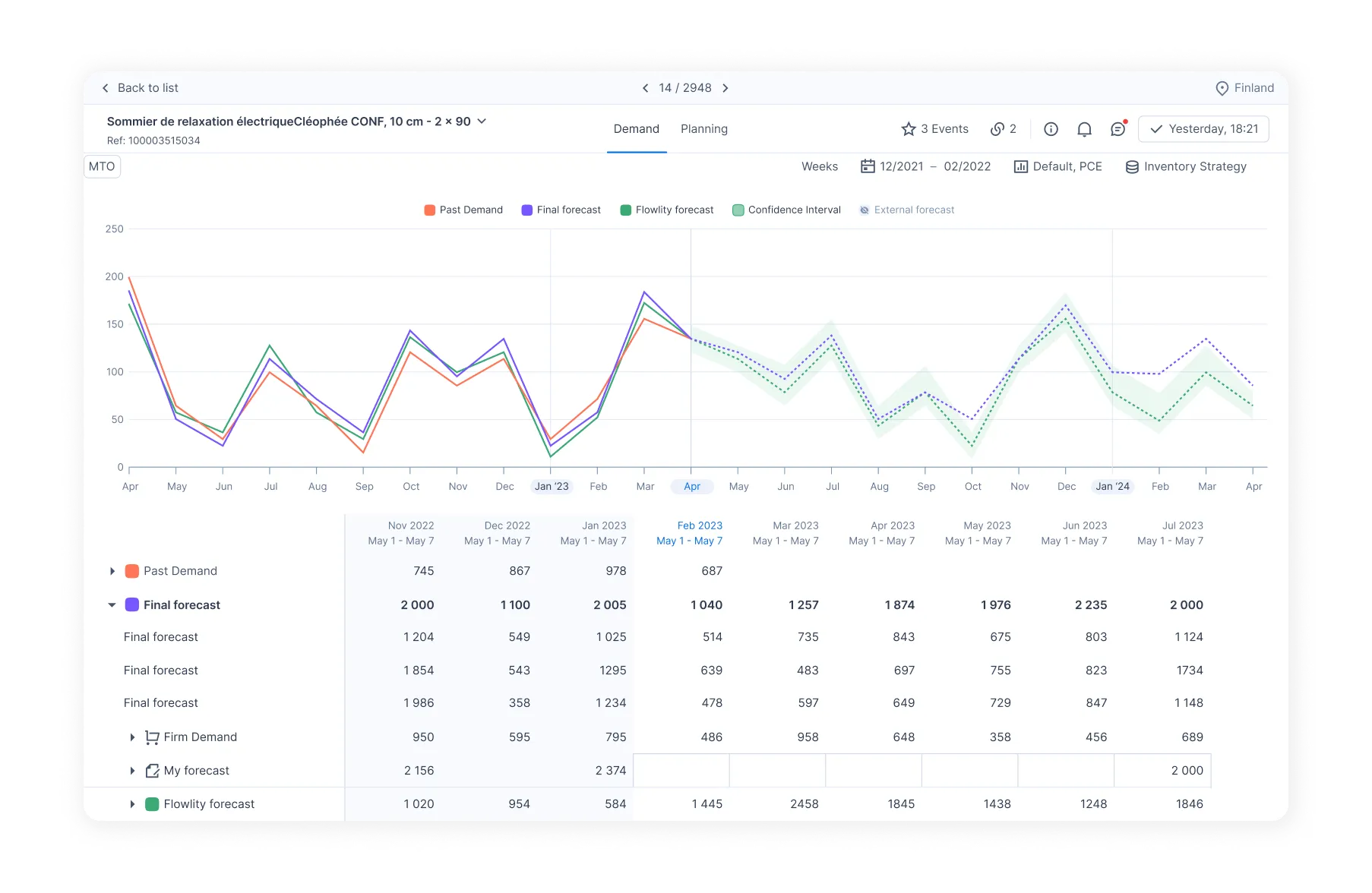
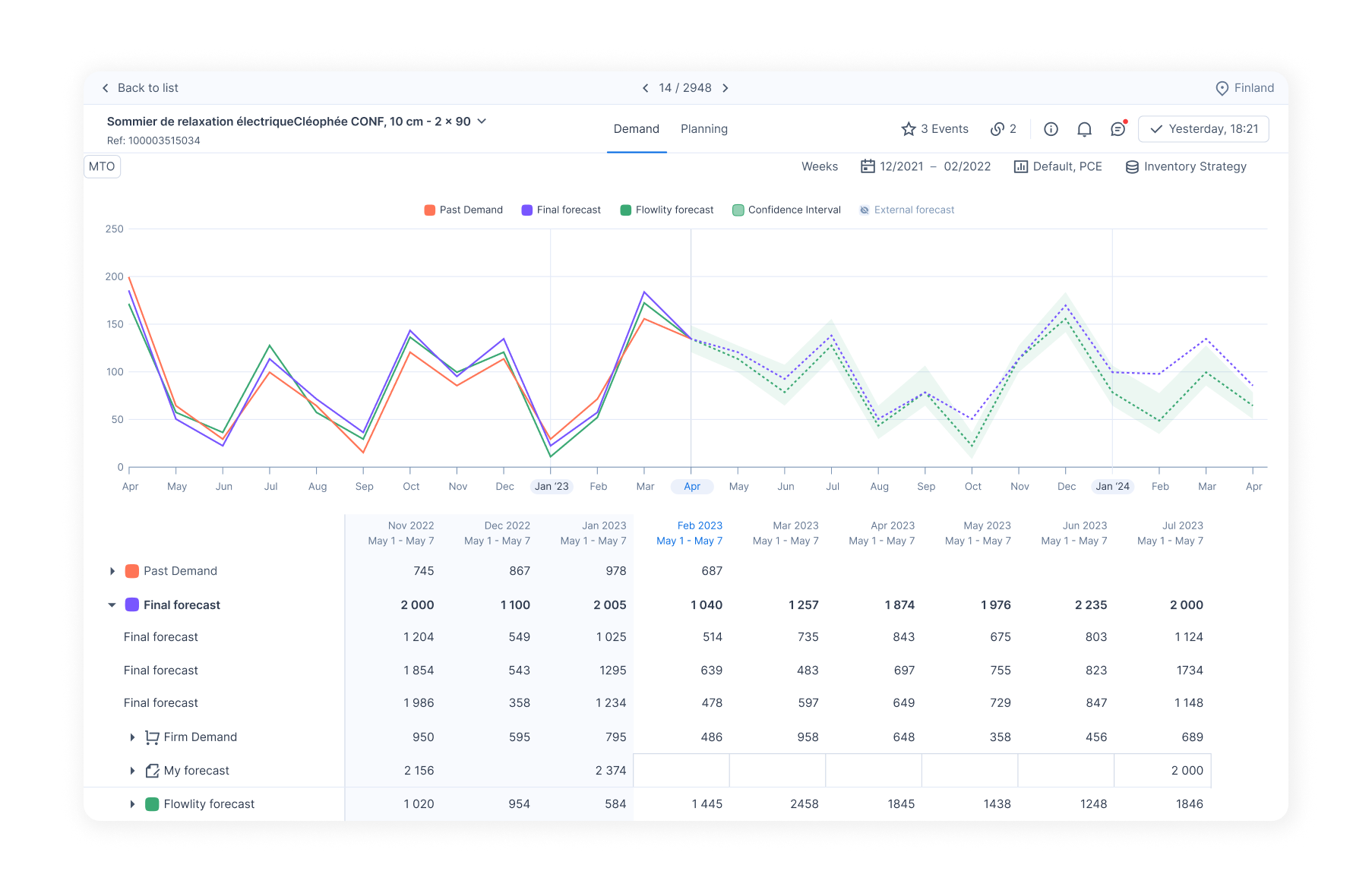
Demand Planning
Accurately forecast future demand at the SKU level to ensure optimal inventory availability and meet customer needs effectively.

.webp)
Inventory Optimization
Leverage data and advanced algorithms to determine the ideal inventory levels for each SKU, minimizing costs while maintaining service levels.
.webp)
Supply Planning
Align your supply with demand forecasts by maintaining appropriate inventory levels and considering specific constraints such as lead times and capacity.
.png)
Sales & operations planning
Synchronize daily operations with strategic objectives to enhance cross-functional collaboration and drive business performance
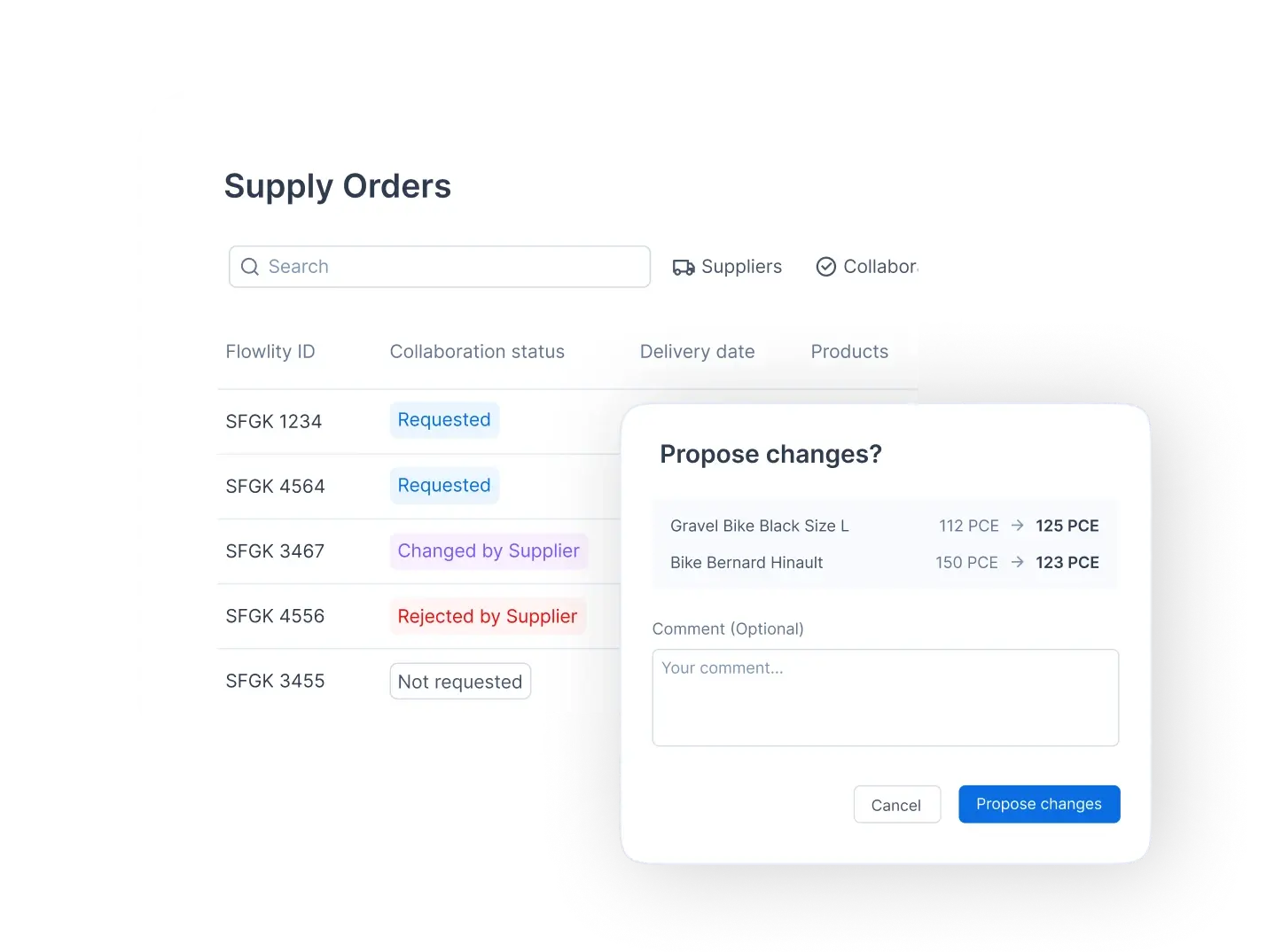
Collaborative planning
Provide real-time visibility to both your team and suppliers, fostering better coordination and responsiveness across the supply chain
.webp)
AI-Powered Margin Management
Flowlity's AI empowers you to optimize your margin by strategically adjusting prices and promotions. Our technology forecasts the impact of your pricing decisions on sales volumes.
Customers
The Flowlity experience is just different. Easy, fast and quick ROI.


.avif)
.svg)
.avif)
.svg)
.avif)
.svg)

.svg)
.avif)
.svg)
.avif)
.svg)

.svg)
Performance


Performance

Performance


accuracy

.svg)
Level up your Supply Chain with AI.
Get a demo
Tech
AI and SaaS native technologies. Highest security standards and fast integration.
.svg)



Everything You Need to Know About Supply Chain Planning Software
And how to choose right.
What is Supply Chain Planning Software (and why it matters more than ever)

Supply Chain Planning Software is the brain behind modern Supply Chain performance. It helps companies anticipate demand, align supply with reality, optimize inventory, and make smarter decisions — faster.
In a world of volatile demand, geopolitical disruptions, supplier uncertainty, and increasing pressure on margins, Excel spreadsheets and rigid legacy tools simply can’t keep up.
At its core, Supply Chain Planning Software enables companies to:
- Forecast demand more accurately
- Plan supply and replenishment based on real constraints
- Optimize Inventory levels across warehouses and production sites
- Improve collaboration between Sales, Operations, Procurement and Finance
- Anticipate risks instead of reacting to them
But not all Supply Chain Planning Software is created equal. Traditional tools rely on static forecasts and fixed heuristics. Modern AI-powered platforms like Flowlity embrace uncertainty instead of ignoring it. They generate probabilistic forecasts, continuously adapt buffers, and recommend actions in real time.
The result?
Less firefighting. More control. And a Supply Chain that works for you — not against you.
What Does Supply Chain Management Software Actually Do?
If you’re asking, “What does Supply Chain Management Software do?” — you’re not alone. In simple terms, it connects data, people, and decisions across your Supply Chain. More specifically, it helps you:
Improve Demand Planning
Accurate Demand Planning is the foundation of everything. AI-driven forecasting analyzes historical sales, seasonality, promotions, trends, and anomalies to produce more reliable forecasts — complete with confidence intervals.
Instead of betting on a single number, you understand uncertainty.
Optimize Inventory Levels
Inventory Optimization ensures you hold the right stock, in the right location, at the right time. That means:
- Fewer stockouts
- Less overstock
- Lower carrying costs
- Better cash flow
Modern systems dynamically adjust Safety Stock based on variability, lead times, and service objectives.
Enable Sales & Operations Planning (S&OP)
Supply Chain Planning Software aligns departments around one single source of truth. No more endless Excel versions.
No more siloed decisions.
No more “whose forecast is correct?”Instead, S&OP becomes collaborative, structured, and measurable.
Increase Visibility Across the Network
Supply Chain Visibility Software enables real-time tracking of Inventory, orders, and supply constraints. It integrates with ERP, WMS, and TMS systems to provide a clear picture of what’s happening. Better visibility means better decisions.
Support Scenario Planning & Simulation
What happens if a supplier is delayed? What if demand spikes 20%? What if you change your service level target?
With simulation capabilities (Digital Twin), you test scenarios before acting. That’s how resilient Supply Chains are built.
How Supply Chain Planning Software Optimizes Inventory Levels
Inventory is often the biggest lever for profitability. Too much stock → cash is frozen. Too little stock → customers leave. This is especially true in Spare Parts Supply Chains, where demand is intermittent, lead times are long, and the cost of a stockout can stop production entirely. AI-powered Supply Chain Planning Software optimizes Inventory by:
Moving from Deterministic to Probabilistic Forecasting
Instead of relying on one forecast value, probabilistic forecasting models generate demand ranges with confidence levels. This enables dynamic Safety Stock sizing based on real variability — not assumptions.
Multi-Level Optimization
Modern platforms optimize across the entire network:
- Production sites
- Distribution centers
- Retail locations
- Suppliers
This end-to-end approach reduces the Bullwhip Effect and prevents local optimizations that damage global performance.
Working by Exception
Instead of reviewing every SKU manually, planners focus only on what truly requires attention: anomalies, risks, and high-impact deviations. At Flowlity, up to 95% of routine planning tasks can be automated — allowing teams to shift from operational firefighting to strategic value creation.
- At Saint-Gobain, improved SKU-level forecasting led to a +15% increase in forecast accuracy and up to 40% inventory reduction, significantly lowering stockout risk and emergency shipments.
- In retail, Sport 2000 achieved a 39% inventory reduction
- Other companies have focused on service performance: Groupe Lemoine improved its service level by 11%, and Ravate increased product availability by 6.3%.
- For growing brands like Camif, reducing stockouts by six points not only protected revenue but enabled the company to absorb +44% growth without increasing logistics headcount.
These are not isolated improvements. They are structural performance gains.
Inventory Optimization is no longer about cutting stock blindly.
It’s about intelligently balancing service, risk, and working capital — with measurable business impact.
How Supply Chain Management Software Improves Visibility
Supply Chain Visibility Software provides a unified, real-time view of:
- Stock levels
- Open orders
- Lead times
- Supplier performance
- Forecast accuracy (MAE, MAPE)
But visibility is not just about dashboards.
True visibility means actionable insights. Modern platforms integrate seamlessly with ERP systems via API, SFTP, or EDI connections. They extract master data, sales history, and supply parameters to continuously refresh planning models. The result:
- Faster reaction to disruptions
- Reduced blind spots
- Better cross-functional collaboration
Visibility is not a luxury. It’s a competitive advantage.
How to Choose the Right Supply Chain Planning Software
Choosing Supply Chain Planning Software is a strategic decision. It impacts operations, finance, and growth. Here’s what to evaluate:
Forecasting Capabilities
Does the solution use Machine Learning? Does it handle outliers automatically? Does it provide probabilistic forecasts? Avoid tools that rely solely on static statistical models if you want to rely on accurate forecasts.
Inventory Optimization Logic
Is Safety Stock dynamic? Can it optimize across multiple echelons? Does it adapt to variability in lead time and demand?
Ease of Implementation
Some legacy APS systems require 12–24 months to deploy. Modern SaaS solutions should go live in weeks — not years. At Flowlity, average go-live happens in less than 2 months.
Total Cost of Ownership (TCO)
Look beyond license price:
- Implementation costs
- Maintenance
- IT infrastructure
- Change management
Cloud-native Supply Chain Software reduces heavy IT burdens.
Usability & Planner Adoption
The most advanced algorithm is useless if planners don’t trust it. User-friendly interfaces, explainable AI, and collaborative features are critical.
Vendor Expertise
Does the vendor understand Supply Chain deeply? Do they provide mesurable ROI proof? Can they support change management? The right partner doesn’t just sell software — they help you transform your Supply Chain.
How to Evaluate Supply Chain Planning Software Vendors
When evaluating vendors, ask the right questions:
- What measurable results have clients achieved?
- How long is the average deployment?
- What industries do they specialize in?
- How do they handle data security and compliance?
- What's their current customers' ROI
Look for:
- Real customer case studies
- Transparent pricing models
- Clear implementation methodology
Supply Chain Planning Software is not a commodity. It’s a strategic partnership.
How Much Does Supply Chain Management Software Cost?
Cost varies significantly depending on:
- Number of SKUs managed
- Number of modules included
- Forecasting horizon
- Supply Chain complexity
- Multi-site production needs
Generally, pricing can range from tens of thousands per year for mid-market companies to enterprise-level investments for global corporations. However, cost should never be evaluated in isolation. The real question is: what is the ROI? If a solution reduces Inventory by 20–40% and cuts stockouts dramatically, the payback period is often short. In many cases, improved working capital alone justifies the investment.
AI-Powered Supply Chain Planning: The Flowlity Approach
At Flowlity, we believe Supply Chain Planning should be:
- Predictive
- Probabilistic
- Dynamic
- Simple to use
Our AI-powered platform was designed specifically for manufacturers, distributors, and retailers struggling with volatility and Excel-based planning.
What Makes Flowlity Different?
- Proprietary probabilistic forecasting algorithms
- Continuous recalibration of Safety Stock
- Digital Twin simulations
- Working by exception
- Collaborative supplier portal
- Cloud-native architecture (Microsoft Azure – France Central)
Unlike heavy legacy APS solutions, Flowlity combines performance with simplicity. We help companies move from Supply Chain stress to Supply Chain control.
FAQ - Supply Chain Planning & Management Software
What are the main features of Flowlity to optimize Supply Chain planning?
Flowlity is an all-in-one platform covering the full Supply Chain planning cycle — from demand forecasting to operational execution — powered by probabilistic artificial intelligence. Its main features work together as a single decision system rather than as isolated modules.
Demand planning
Flowlity generates reliable sales forecasts using your historical and external data. Its probabilistic algorithm produces several scenarios, identifies the most likely one, and provides a confidence interval so planners can see uncertainty rather than hide it.
Inventory optimization
The platform recommends optimal stock levels for every SKU-location and calculates dynamic replenishment thresholds, alerting on imminent stockouts or overstocks.
Supply Planning
Flowlity generates replenishment proposals that respect MOQ, lot sizes, lead times, and capacity constraints, and can lift product availability by up to +50% while reducing excess.
Production Planning
For manufacturers, Flowlity builds capacity-feasible production plans, integrates bills of materials, and decides where to position buffer stocks to maximize on-time delivery.
S&OP and reporting
Real-time dashboards feed the monthly S&OP cycle, aligning demand, supply, and finance around one shared view of stock coverage, shortage projection, and capacity.
Supplier-customer collaboration
Flowlity offers a collaborative space to share forecasts, needs, and order confirmations with your partners — streamlining communication and reducing uncertainty along the chain.
Pricing & Promotions Management
An AI-powered Pricing Optimization & Promotions Management software simulates pricing and promotional scenarios, visualizes their impact on volumes and margins, and keeps pricing decisions aligned with supply capacity.
Overall, Flowlity automates up to 95% of planning activities while keeping planners in control — delivering inventory reductions of up to 60% and higher service rates. Contact us to see it applied to your scope.
How does AI improve supply chain planning in 2026?
In 2026, AI in supply chain planning goes beyond dashboards. It enables:
- Predictive analytics to anticipate shortages and market conditions
- Automated planning workflows to reduce manual work and silos
- Real-time visibility across inventory, sourcing, and warehouse management
This results in higher operational efficiency and faster response to disruptions.
What do a Supply Chain Management Software actually do?
A Supply Chain Management Software centralizes data and supports better decision-making across your entire Supply Chain.
Concretely, it helps you:
- Forecast customer demand more accurately
- Plan supply and replenishment based on real constraints
- Optimize Inventory levels across warehouses and production sites
- Improve collaboration between Sales, Operations, Procurement and Finance
- Anticipate risks instead of reacting to them
Instead of working in disconnected Excel files or relying solely on ERP outputs, the software becomes a decision-support engine.
The goal is simple:
Reduce stockouts, cut excess Inventory, and improve Service Level — simultaneously.
How does Supply Chain Planning Software optimize Inventory levels?
Inventory optimization is not about cutting stock blindly. It’s about balancing service, cost, and risk.
Modern Supply Chain Planning Software use:
- AI-driven demand forecasting
- Variability analysis (lead time + demand volatility)
- Dynamic Safety Stock calculations
- Multi-echelon optimization across the network
Instead of fixed buffers, the system continuously adjusts Inventory policies based on real data.
This means:
- Lower working capital
- Fewer emergency orders
- Fewer zero-stock days
- Higher customer satisfaction
The most advanced platforms use probabilistic forecasting to model uncertainty — allowing companies to set service targets based on risk tolerance, not guesswork.
How to choose the right Supply Chain Management Software for your company?
Choosing the right solution requires looking beyond features.
Here are the key evaluation criteria:
1. Forecasting sophistication
Does the tool rely on static models, or does it use Machine Learning and probabilistic forecasting?
2. Inventory logic
Is Safety Stock dynamic? Can it optimize across multiple sites?
3. Implementation speed
Will it take 18 months — or 8 weeks?
4. Ease of use
Will planners adopt it? Is it intuitive?
5. Total Cost of Ownership (TCO)
What are the hidden IT, maintenance, and customization costs?
6. Vendor expertise & ROI proof
Can the vendor demonstrate measurable results in companies similar to yours?
The best solution is not the most complex one.
It’s the one that delivers measurable impact quickly.
How should you evaluate Supply Chain Planning Software vendors?
When evaluating vendors, focus on outcomes — not marketing claims.
Ask:
- What average Inventory reduction do clients achieve?
- How long until ROI is reached?
- What industries are you strongest in?
- Can you simulate my potential gains before I sign?
- How do you handle data security and compliance?
Also assess the partnership dimension:
- Is there a dedicated Customer Success team?
- Do they support change management?
- Are they responsive and transparent?
Supply Chain transformation requires internal alignment.
Your software provider should act as a long-term strategic partner — not just a vendor.
How much does a Supply Chain Management Software typically cost?
Pricing usually varies depending on:
- Number of SKUs managed
- Supply Chain complexity
- Modules required (Demand Planning, Inventory, S&OP, etc.)
- Forecasting horizon
- Number of production sites
- ...
Mid-market SaaS solutions often start in the tens of thousands per year, while large enterprise systems can reach significantly higher budgets.
However, cost should always be evaluated against potential ROI:
- Inventory reduction
- Fewer shortages
- Improved Service Level
- Reduced manual planning time
In many cases, the working capital savings alone justify the investment.
The real question isn’t: “How much does it cost?”
It’s: “How much is my current inefficiency costing me?”