.svg)
Plan and synchronize distribution flows with AI-powered DRP software
Move inventory through the network with confidence with Flowlity’s AI-driven DRP software. Anticipate downstream needs and plans distribution flows under demand uncertainty.
Get a Demo
Synchronize flows across the distribution network
Distribution only works when the network moves together.
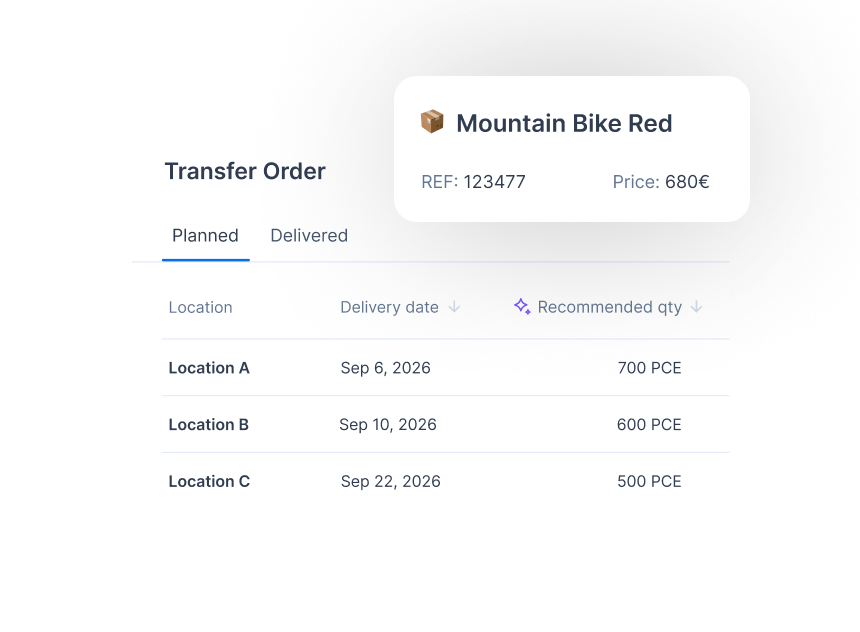
Time-phased distribution requirements
.svg)
Demand-driven flow planning
Anticipate downstream distributionneeds
Know what to ship, where—and when.
.svg)
Multi-node flow coordination
Smoother network execution
Plan distribution flows under demand uncertainty
Deterministic DRP breaks when reality shifts.
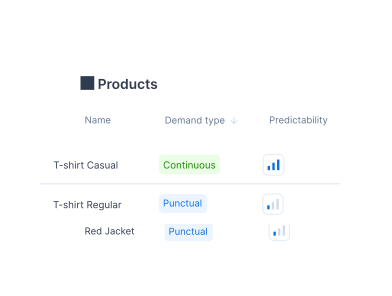
Probabilistic flow anticipation
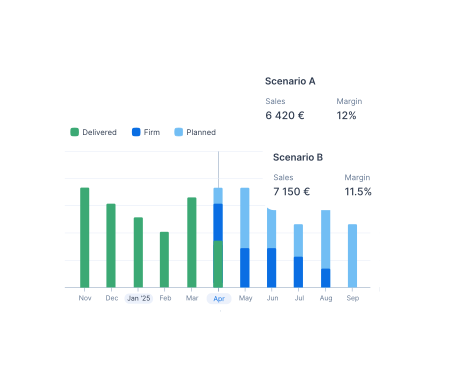
Scenario-based flow simulation
From reactive transfers to proactive distribution flow planning


DRP software: take control of your distribution instead of reacting to it
Most Supply Chains don’t lack data — they lack control over how inventory flows across their network.
Bringing clarity and control to distribution decisions

Most distribution issues don’t come from a lack of tools. They come from fragmented planning.
One warehouse is overstocked, another is running out. Transfers are triggered too late. Decisions are made in Excel because the system can’t be trusted.
Over time, planners end up spending more time fixing problems than actually planning.
What DRP software changes is not just the process — it changes how decisions are made.
Instead of reacting to issues after they occur, teams can continuously answer a simple but critical question:
What should we move, where, and when?
This shift allows planners to anticipate imbalances before they impact service levels. Inventory is no longer managed in silos but coordinated across the network. Flows become aligned, and decisions become proactive rather than reactive.
The real value doesn’t come from automation alone. It comes from giving teams the ability to focus on decisions that improve performance, not just corrections.
This is where DRP becomes truly powerful when connected with Inventory Management and a clear operational dashboard — because visibility only creates value when it leads to action.
Why traditional DRP tools don’t work anymore
Many companies already have DRP capabilities embedded in their ERP. On paper, the functionality exists. In reality, it is often bypassed.
The reason is simple: the logic behind traditional DRP no longer matches today’s Supply Chain conditions.
These systems were designed for relatively stable environments. They rely on fixed safety stock rules, single-point forecasts, and planning cycles that don’t adapt quickly to change.
But Supply Chains today are anything but stable.
Demand fluctuates constantly. Suppliers are less predictable. Promotions, seasonality, and external events introduce variability that static models cannot absorb.
To cope with this, companies add buffers. More stock, more safety margins, more “just in case”.
And yet, the paradox remains: inventory increases, but service levels don’t necessarily improve.
Saint-Gobain experienced this exact situation. By changing how distribution decisions were made — moving away from static rules toward a more dynamic approach — they were able to reduce inventory while simultaneously lowering stockout risk, as detailed in this Saint-Gobain case study on Supply Chain Planning optimization.
This is where traditional DRP reaches its limits. It was designed to calculate — not to adapt.
What really matters when selecting a DRP solution (features, criteria…)
Choosing a DRP software is less about features and more about fit.
The key question is not “what does the tool do?” but rather: Will it work in the reality of my Supply Chain?
First, the system needs to understand the network as a whole. Inventory decisions made in one location always impact others. Treating warehouses independently leads to suboptimal results. This is why approaches like MEIO are critical — they ensure inventory is positioned where it brings the most value across the network.
Second, DRP cannot operate in isolation. If it is disconnected from Supply Planning, the plan becomes theoretical. What looks optimal on paper may not be feasible operationally.
Third, usability is essential. Even the most advanced system will fail if planners don’t trust it. Recommendations must be understandable, explainable, and actionable. A well-designed Supply Chain dashboard is often the difference between adoption and rejection.
Finally, implementation speed is a decisive factor. In a fast-moving environment, a solution that takes over a year to deploy risks becoming obsolete before it delivers value.
What DRP software actually changes in your day-to-day operations
There is a point where distribution complexity outgrows manual planning. It usually happens gradually. Networks expand, product portfolios grow, and variability becomes harder to control. At first, teams compensate. Then the cracks start to show.
One warehouse is overstocked. Another is out of stock. Transfers happen too late. Decisions are made in Excel. And planners spend their time reacting instead of anticipating.
At that stage, the symptoms are clear: recurring inventory imbalances, growing reliance on manual adjustments, and increasing pressure on planning teams. This is not a tooling problem. It’s a coordination problem. And it becomes even more visible depending on your context.
In retail, for example, keeping stores aligned with central inventory is a daily challenge. Without structured Store Replenishment, some locations run out too early while others accumulate excess stock.
In wholesale, the balance is tighter. Service levels must remain high, but margins leave little room for inefficiency. Poor distribution decisions quickly translate into lost profitability.
In Spare Parts Supply Chains, the stakes are different but just as critical. Demand is unpredictable, yet availability must be guaranteed. A missing part can mean downtime, delays, or lost revenue.
In all these situations, the same issue appears: the network is not synchronized.
What performance gains look like beyond theory
The impact of DRP is best understood through real outcomes, not theoretical benefits.
At Camif, improving distribution planning didn’t just reduce stockouts. It enabled the company to handle a significant increase in activity without adding operational resources. The planning process scaled with the business instead of becoming a bottleneck.
At Plum, the challenge was different. Inventory was not necessarily too high everywhere — it was poorly positioned. By rebalancing stock across the network, they achieved a substantial reduction in inventory value while maintaining service levels.
These examples highlight a key point: DRP is not about optimizing isolated metrics. It’s about improving how the entire Supply Chain operates.
Less friction. Fewer urgent decisions. More control.
Moving from reactive planning to controlled execution
Without structured distribution planning, most Supply Chains operate in reaction mode. A shortage appears, and teams respond. A delay occurs, and adjustments are made. Demand spikes, and the system struggles to keep up.
DRP changes the timing of decisions.
By continuously analyzing demand signals, inventory levels, and supply constraints, the system identifies risks earlier. This allows planners to act before problems materialize. Instead of reacting to shortages, they can rebalance inventory proactively. Instead of adjusting plans after disruptions, they can simulate scenarios and prepare in advance.
Over time, this shift reduces volatility across the network. When combined with Inventory Management and Supply Planning, DRP becomes more than a planning tool. It becomes a control layer that stabilizes execution and improves overall performance.
Why companies move away from ERP-based DRP toward Flowlity
Most DRP tools originate from ERP systems. They were designed to support planning — but not necessarily to handle uncertainty. Flowlity was built with a different starting point: variability.
Instead of relying on static rules, it continuously adapts to what is happening in the Supply Chain. It highlights risks early, suggests concrete actions, and allows planners to make informed decisions faster.
This changes the role of the planner. From someone who adjusts plans manually… to someone who pilots the Supply Chain with the support of AI-powered intelligent recommendations.
And just as importantly, it changes the speed of transformation. No heavy IT projects. No multi-year deployments. Companies can start improving their performance quickly — reducing inventory, improving service levels, and freeing up time for their teams.
Because at the end of the day, the goal is not better planning tools. It’s a Supply Chain that is simpler to run and more resilient to change.
FAQ about distribution requirements planning software
Find everything you need to know right here.
What does DRP stand for in Supply Chain management?
DRP stands for Distribution Requirements Planning. It is a Supply Chain planning method used to determine how much inventory should be distributed, when products should be replenished, and where stock should be located across a distribution network of warehouses, regional hubs, and stores.
The underlying logic is to translate expected customer demand into a coherent plan of inter-site transfers and replenishment orders, so that stock sits as close as possible to the point of sale without creating excess at any single node.
DRP ensures that inventory flows between warehouses, distribution centers, and stores are synchronized with demand — avoiding the classic pattern where one regional hub is stocked out while another is overstocked with the same SKU.
What is the difference between DRP and MRP?
DRP and MRP are often confused because both deal with planning, but they operate on different halves of the Supply Chain and answer different questions.
DRP and MRP address different parts of the Supply Chain.
MRP (Material Requirements Planning) focuses on production planning. It determines which raw materials and components are needed to manufacture products.
DRP, on the other hand, focuses on distribution. It determines how finished products should be allocated across warehouses and distribution centers.
In many organizations, DRP works alongside:
- Demand Planning
- Inventory Optimization
- Supply Planning
Together these processes ensure that products are produced and distributed efficiently.
In practice, the distinction matters because the two systems optimize different trade-offs: MRP minimizes production disruption and component shortages, while DRP minimizes distribution imbalances and stockouts at the point of sale. Modern platforms like Flowlity integrate both views so that production and distribution stay synchronized as demand evolves across the network.
What is DRP software used for?
DRP software is used to plan how products move across a distribution network. It helps companies decide how much stock is needed at each location, when to replenish, and how to rebalance inventory between warehouses when local demand shifts faster than the plan.
In practice, a DRP tool takes demand forecasts, current inventory positions, in-transit stock, and lead times as inputs, then generates a time-phased replenishment plan for every SKU × location combination. The goal is simple: maximize product availability while minimizing total network inventory.
Modern DRP software like Flowlity adds AI-driven forecasting and probabilistic inventory targets on top of this — so replenishment decisions reflect actual demand variability rather than static reorder points that quickly drift out of sync with reality.
What is the difference between DRP and inventory management?
Inventory management focuses on tracking and controlling stock levels: what's on hand, what's in transit, what's reserved, and when items are received or issued. It is essentially an operational and accounting view of stock at a given moment.
DRP goes further. It plans how inventory should flow across the network over time — deciding when to push or pull stock between nodes, what quantities to replenish, and how to sequence orders so that every site remains in balance as demand evolves.
In practice, DRP works on top of inventory management: the ERP or WMS keeps the record of what you have, while DRP decides what you should do next to match that stock to future demand.
Who uses DRP software?
DRP software is used by Supply Chain professionals responsible for managing inventory and distribution networks. Typical users include Supply Chain directors, demand planners, inventory managers, and distribution planners — anyone whose day-to-day decisions shape where stock sits and how it moves.
The industries that most commonly deploy DRP solutions are retail, wholesale distribution, manufacturing, and spare-parts networks. What these organizations have in common is a multi-echelon footprint — several warehouses, regional depots, or stores — where local decisions compound quickly into network-wide imbalances.
They rely on DRP to maintain high service levels while controlling inventory costs, especially when product ranges are large and demand patterns differ between locations. For mid-market companies, modern DRP tools make this possible without the headcount or IT budget traditionally needed for this kind of planning.
How does DRP software reduce inventory and stockouts at the same time?
It sounds counterintuitive, but reducing inventory and reducing stockouts come from solving the same problem: poor inventory positioning.
Most companies try to avoid stockouts by adding safety stock everywhere. The result? More inventory… but still shortages in the wrong places.
DRP software takes a different approach. Instead of protecting each warehouse individually, it optimizes inventory across the entire network. It continuously analyzes:
- demand signals (by location and SKU)
- current stock levels across all nodes
- lead times and supply constraints
Based on this, it determines where inventory is actually needed, not just where it happens to be.
In practice, this means:
- less excess stock sitting in low-demand locations
- better availability where demand is real
- earlier detection of potential shortages
- smarter transfers between warehouses instead of emergency orders
For example, companies like Camif have reduced stockouts while scaling their operations, and others like Plum have significantly lowered inventory value — not by cutting blindly, but by placing stock where it creates value.
The key is simple: not more stock — better distributed stock.
Is having a DRP software relevant for small and mid-size companies?
Absolutely — and in many cases, mid-size companies benefit the most. The reason is that Supply Chain complexity tends to grow faster than headcount: a new warehouse, a few added product lines, or international expansion quickly pushes spreadsheet-based planning past its limits. Yet these same companies rarely have the budget or IT bandwidth for a heavy enterprise planning suite.
Modern DRP tools solve that gap. Cloud-native platforms like Flowlity connect to existing ERP systems in a few weeks, require no dedicated data science team, and deliver AI-driven replenishment recommendations out of the box.
This allows mid-size companies to structure their Supply Chain with enterprise-grade logic — dynamic safety stock, multi-echelon visibility, exception-based workflows — without adding the operational complexity that comes with legacy platforms. It's planning maturity without the implementation overhead.
How long does it take to implement DRP software?
Implementation time depends heavily on the type of solution. Traditional ERP-based DRP modules typically take anywhere from 6 to 18 months to go live, because they require deep configuration, custom data integrations, and often a parallel change-management program involving several teams.
Modern cloud-native solutions like Flowlity are engineered for a very different timeline. Pre-built connectors to major ERP systems, a planner-centric interface that requires little training, and a SaaS architecture that eliminates infrastructure setup mean most mid-market deployments go live in weeks rather than months.
Plum Living, for example, went live across 630 SKUs and 2 warehouses and achieved a 21% inventory reduction at go-live. The deciding factor is data readiness — if orders, sales, and inventory are already tracked at the SKU level, the rest moves fast.
What is the difference between traditional DRP and AI-powered DRP software?
Traditional DRP and AI-powered DRP solve the same problem — balancing network inventory against expected demand — but in very different ways. Traditional DRP systems, usually embedded inside an ERP, are built on fixed rules such as static safety stock levels and reorder points, deterministic forecasts that produce a single "best guess" for demand, and planning cycles that run weekly or monthly.
This works reasonably well in stable environments. But as soon as variability increases — promotions, new product launches, supply disruptions, channel shifts — these systems become rigid and require constant manual adjustments, which is why planners so often end up back in Excel.
AI-powered DRP like Flowlity replaces static rules with probabilistic demand models and continuously adapted inventory targets. Instead of one forecast, the system works with a range of likely outcomes and confidence levels, then flags only the exceptions that require planner attention. The result is fewer firefights and more reliable service levels.