.svg)
Smarter supply order management, powered by AI and grounded in real-world constraints.
Move beyond execution-only order management software. Align order commitments, prioritization and fulfillment decisions with demand forecasts, inventory targets and supply realities.
Get a Demo.svg)
Make realistic order commitments
Promise only what your supply chain can truly deliver.
.svg)
Supply-aware order promising
Reliable delivery commitments
Prioritize orders when supply is constrained
Not all orders should be treated the same.
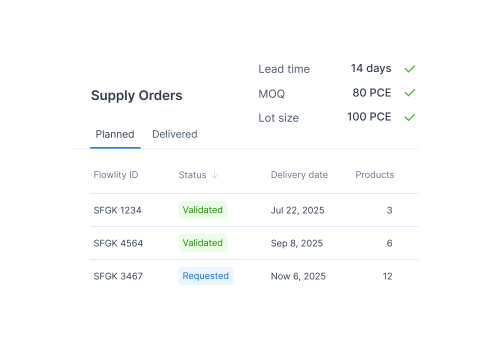
Intelligent order prioritization
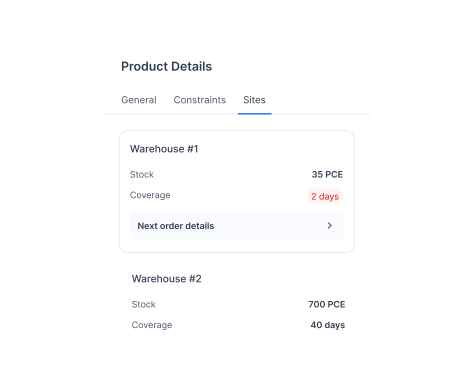
Shortage and allocation management
Connect order management with supply chain planning
Orders shouldn’t live in isolation.
.svg)
Orders aligned with demand and inventory plans
.svg)
Decision-driven order management
From execution-focused OMS to supply-driven order management


Smarter supply ordering starts with smarter planning
Why most ordering processes waste planner time

Most Supply Chain teams know the feeling: dozens of purchase orders to review every day, most of them routine, yet each one requiring a manual check before it goes out. The root cause isn't a lack of discipline — it's that traditional ERP-based ordering treats every replenishment the same way, regardless of whether it's a standard restocking or a high-stakes commitment during a shortage.
This one-size-fits-all approach has real costs. Planners end up buried in transactional work, double-checking quantities that could have been validated automatically. Meanwhile, the orders that actually need attention — a supplier running late, a demand spike on a key product, a margin risk on a large commitment — get the same rushed treatment as everything else. The issue isn't the volume of orders. It's the inability to distinguish what matters from what doesn't.
Teams that have moved toward automated Supply Planning often find that fixing the ordering layer is the natural next step: once your forecasts and inventory targets are reliable, it makes little sense to still process every order by hand.
What to look for in a modern ordering solution
Planning integration
Not all ordering tools are created equal. Some focus purely on Purchase Orders (PO) workflows — approvals, routing, supplier communication — without touching the logic behind what gets ordered and when. Others sit inside ERPs and inherit their rigidity: fixed reorder points, static lead times, no awareness of what's actually happening in demand.
The real differentiator is whether the solution connects Supply Chain order management to your planning layer. Can it factor in your latest demand forecasts when calculating quantities? Does it adjust for supplier lead time variability? Can it incorporate your MRP or DRP logic instead of working in a silo?
Scalability
Scalability also matters. Many mid-market companies in wholesale or manufacturing start by automating their top suppliers and quickly realize they need the same intelligence across their entire portfolio. A solution that requires months of configuration per supplier won't keep up. For retailers especially, where SKU proliferation and seasonal swings add constant pressure, following proven best practices for retail Supply Chain automation can mean the difference between scaling smoothly and drowning in manual adjustments.
Automate the routine, focus on what counts
The biggest productivity gain doesn't come from speeding up order processing — it comes from eliminating unnecessary processing altogether. When a replenishment is straightforward (stable demand, reliable supplier, standard quantity), there's no reason a planner should spend time on it. It should be calculated, validated, and sent automatically.
What planners actually need is a system that surfaces only the exceptions: an order where the committed quantity exceeds a margin threshold, a supplier whose recent delivery performance suggests a risk, a product where demand has shifted significantly since the last plan. That's where human judgment creates value — not in rubber-stamping routine POs.
This is the logic behind exception-based ordering. Platforms like Flowlity use AI agents to handle the full cycle for standard orders while flagging the critical few that deserve attention. The planner's dashboard becomes a decision cockpit, not a processing queue.
Plum Living, a furniture brand managing 630 SKUs across two warehouses, experienced this first-hand: after replacing manual spreadsheet-based ordering with Flowlity, they reduced inventory by 21% at go-live — and over time, their inventory value dropped by 38%.
Orders that reflect Supply Chain reality
One of the most common problems with traditional Supply Chain order management is that purchase quantities are disconnected from what's actually happening in the business. Reorder points were set six months ago. Safety stock levels don't reflect recent demand shifts. Supplier lead times in the system don't match reality.
The result? Orders that are technically "on time" but strategically wrong — too much of one product, not enough of another, and constant firefighting to patch the gaps. As research on collaborative planning and replenishment has shown, the most effective organizations are those that align execution with planning, not those that optimize them separately.
Flowlity addresses this by generating every purchase order from live data: AI-driven demand forecasts, optimized safety stock levels, real-time inventory visibility across your network, and supplier lead time distributions. The order isn't just placed — it's right-sized, right-timed, and aligned with what your Supply Chain can actually support.
Saint-Gobain Sekurit saw this in action at scale: managing over 10,000 automotive glass references across 30 distribution centers and 3 plants, they improved product availability from 95.8% to 97.2% while reducing inventory by 9.25% — because every order was finally grounded in accurate, AI-enhanced forecasts rather than outdated parameters.
How Flowlity changes the way teams manage orders
Planning-first ordering
Flowlity doesn't bolt an ordering layer onto your ERP — it rethinks the process from the planning side. Purchase orders are generated from the same tool that produces your demand forecasts and inventory targets, which means every order is already coherent with your broader Supply Chain strategy.
Automated routine, flagged exceptions
For routine replenishments, the cycle is fully automated: Flowlity calculates the optimal quantity, validates it against your business rules, and sends it to the supplier. Planners don't see these orders unless something is flagged. For complex situations — constrained supply, high-value commitments, new product introductions — the system presents the trade-offs through a clear dashboard so teams can decide with confidence.
Tangible impact
The impact is tangible. Camif, a sustainable e-commerce retailer, absorbed 44% revenue growth without adding a single person to its Supply Chain team after implementing Flowlity. Stockouts dropped by 6 percentage points — unlocking an estimated €40k in additional annual revenue — and the team saved the equivalent of 1 FTE on order processing alone. It's not about removing the planner from the process — it's about making sure their time goes where it matters most.
Getting started without a transformation project
One concern that holds companies back is the fear of a long, complex implementation. Enterprise ordering platforms often require months of configuration, dedicated IT resources, and deep ERP customization before they deliver any value.
Flowlity takes a different approach. The platform connects to your existing ERP (SAP, Oracle, Microsoft Dynamics, and others) and can go live in weeks. There's no need to replace your current systems — Flowlity works alongside them, enriching your ordering process with planning intelligence that your ERP simply doesn't have.
This makes it particularly well-suited for mid-market teams that need results fast. Whether you're a wholesale distributor managing thousands of SKUs or a manufacturer balancing complex supplier networks, you can start with your most critical flows and scale from there — at your own pace.
And once planners reclaim the hours they used to spend on routine order processing, they can redirect that time toward work that truly drives performance: improving supplier terms, preparing for seasonal peaks, managing disruptions proactively, and contributing to S&OP discussions with real, data-backed insights. For organizations looking to move from reactive execution to proactive, AI-driven planning, optimizing supply chain and order management is one of the highest-ROI starting points — and with Flowlity, one of the fastest to implement.
FAQ
Find everything you need to know right here.
What is supplier order management software?
Supplier order management software is a system that automates and optimizes the creation, validation, and tracking of purchase orders sent to suppliers. It covers the full order lifecycle — from calculating replenishment needs based on demand and inventory, to generating and dispatching purchase orders, to monitoring delivery performance and managing exceptions.
Basic tools treat this as a transactional flow: convert a requirement into a PO, send it, track it. Advanced solutions go much further by connecting every order to demand forecasts, inventory policies, and broader Supply Chain planning, so that each PO reflects actual future need rather than a static reorder point set months ago.
This end-to-end alignment is what separates modern AI-driven order management from legacy purchasing systems that still operate largely in isolation from planning.
What is the difference between order management and procurement?
Procurement and order management operate at two different layers of the supply flow. Procurement is the strategic function: sourcing suppliers, running RFPs, negotiating commercial terms, qualifying and managing supplier relationships over time. It answers the questions "who do we buy from?" and "on what terms?"
Order management focuses on the execution layer — generating purchase orders, tracking fulfillment, managing exceptions, and closing the loop with receiving and invoicing. It answers "when, how much, and how effectively are those orders actually placed?"
The two functions depend on each other. Procurement defines the framework; order management makes sure every transaction respects that framework. Modern Supply Chain platforms integrate both so that procurement strategies — preferred suppliers, contracted volumes, commercial terms — are automatically reflected in every order decision, without manual handoffs.
Supplier order management vs. traditional MRP: what's the difference?
Traditional MRP (Material Requirements Planning) calculates what materials are needed based on bills of materials, production schedules, and on-hand inventory. It generates order suggestions in a deterministic way: given these inputs, here is exactly what to buy. The logic is proven but rigid — it does not account for demand variability, supplier reliability, multi-echelon inventory positions, or real-time signals from the rest of the Supply Chain.
Supplier order management software takes MRP outputs further by applying AI-driven optimization on top of them. Routine orders that fit within policy are automated end-to-end; exceptions — orders that exceed margin, volume, or risk thresholds — are surfaced to planners for review.
The result is a step up in supply intelligence: raw material requirements become risk-adjusted, supply-aware purchase decisions instead of unchecked MRP output that planners rework in Excel.
What is the difference between supply order management and order-to-cash?
Order-to-cash (O2C) covers the sales side: from receiving a customer order to invoicing and payment collection. Supply order management sits on the buy side: it manages purchase orders sent to suppliers to replenish inventory and fulfill demand. While both involve order workflows, they serve opposite ends of the Supply Chain. Companies need both to run smoothly, but the planning intelligence required on the supply side — connecting orders to forecasts, safety stocks, and supplier constraints — is fundamentally different from O2C process optimization.
How does Flowlity automate supplier order management?
Flowlity uses AI to generate optimal purchase orders based on probabilistic demand forecasts, dynamic inventory targets, and actual supplier lead time data rather than static reorder points. The engine works at the SKU-supplier level, so every recommendation reflects the specific demand pattern, variability, and lead time reliability of that item and source.
Routine replenishment orders that fall within defined policies are calculated, validated, and sent automatically without manual review. Orders that cross defined thresholds — unusual margin impact, elevated supply risk, volume anomalies, or new supplier conditions — are flagged as exceptions for planner review, with a clear explanation of why the threshold was triggered.
This covers the full cycle from order suggestion to supplier dispatch, including order confirmations and change management. Planners stop processing the 80% of orders that are routine and focus on the 20% where their expertise makes the difference.
Can Flowlity connect order management to demand forecasting?
In most Supply Chains, order management and demand planning live in different tools — and often in different teams. Orders get placed against reorder points set months ago, demand signals evolve continuously, and the gap between the two is absorbed as excess stock or as stockouts. Flowlity is built to close that gap by design.
Yes — this is a core differentiator. Unlike standalone order management tools that rely on static reorder points, Flowlity connects every purchase order to its AI-powered demand forecasts and inventory optimization engine. This means order quantities and timing reflect actual expected demand, forecast confidence levels, and safety stock targets rather than fixed rules set months ago. The result is orders that are consistently right-sized, reducing both stockouts and excess inventory.
This tight coupling is what allows purchase orders to stay right-sized as conditions change, rather than drifting out of alignment between planning cycles. Planners no longer spend their time manually reconciling forecast updates with reorder parameters: the system does it continuously, and flags only the orders that require a human decision because a threshold has been crossed.
What types of companies benefit most from AI-driven order management?
AI-driven supplier order management delivers the highest impact for mid-market companies in retail, wholesale distribution, and manufacturing that manage a large number of SKUs across multiple suppliers. These organizations typically have lean planning teams that spend too much time on routine orders, leaving little capacity for strategic work. Companies managing seasonal demand, long or variable supplier lead times, or complex multi-location replenishment see particularly strong results — often achieving significant inventory reductions while improving service levels.