.svg)
Optimize service level with AI-powered store replenishment software
Balance availability and inventory at store level. Level up your Supply Chain with AI-driven replenishment decisions based on probabilistic demand forecasts and exception-based management.
Get a DemoWith Flowlity, we're now at an average 97% availability rate across our 30 distribution centers — up two points compared to the previous year." »

Reduce stockouts and store inventory
Availability without excess stock.
Demand-driven store replenishment
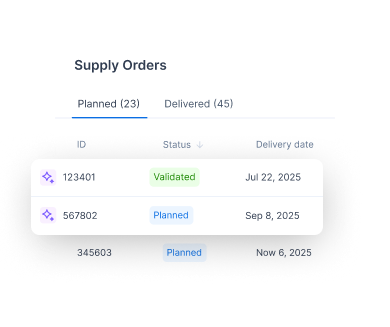
Smarter order quantities per store
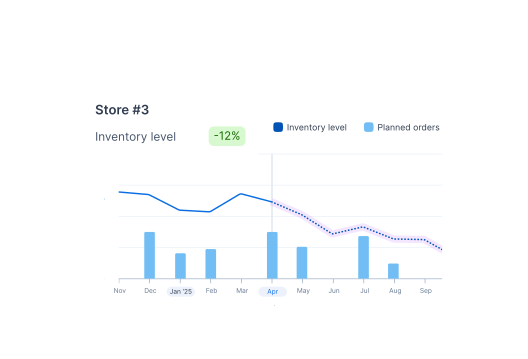
Adapt replenishment to localdemand and volatility
Every store behaves differently.
.svg)
Store-level demand intelligence
In-season adjustments
Automate replenishment without losing control
Focus on exceptions, not routine decisions.
.svg)
Exception-based store management
.svg)
Store prioritization under constraints
From manual store replenishment to intelligent automation


Store replenishment software
From reactive planning to optimized inventory flows
Why store replenishment remains a challenge in modern Supply Chains

In many organizations, store replenishment still relies on a combination of spreadsheets, static rules, and manual adjustments. This approach may work in stable environments, but it quickly reaches its limits as complexity increases.
As soon as you manage multiple locations, large product catalogs, or volatile demand, the same issues start to appear: stockouts on high-demand items, excess inventory in the wrong places, and teams constantly reacting instead of anticipating.
In the Retail industry, product availability directly impacts customer experience. As explored in our whitepaper on customer experience challenges in retail Supply Chains, even small disruptions in availability can translate into lost revenue and decreased loyalty.
The root problem is not operational. It lies in the inability of traditional tools to handle variability at scale.
Store replenishment software to improve store inventory decisions
The role of store replenishment software is often reduced to automation. In reality, its purpose is much broader: improving decision-making across the Supply Chain.
Every replenishment decision involves a trade-off between service level, inventory cost, and operational constraints. Static rules cannot capture this complexity.
Modern solutions address this by continuously adjusting decisions based on real-time data, including demand signals, stock levels, and supply constraints. When combined with Inventory Optimization, replenishment becomes part of a broader strategy that ensures inventory is positioned where it creates the most value.
This shift transforms replenishment from a repetitive task into a driver of performance.
How AI improves replenishment accuracy and responsiveness
Traditional planning tools rely on a single forecast and fixed parameters such as reorder points or safety stock. These assumptions do not hold in environments where demand fluctuates and uncertainty is constant.
AI-driven approaches introduce a different logic. Instead of predicting one outcome, they model a range of possible scenarios and continuously adjust decisions as new data becomes available.
Probabilistic demand forecasting
Rather than producing a single number, probabilistic forecasting generates a range of possible demand outcomes with associated probabilities. This allows planners to understand uncertainty and make decisions that are robust to variability.
Instead of overreacting or overstocking “just in case”, companies can position inventory more precisely based on risk levels and service targets.
This approach is one of the key drivers behind improved forecast accuracy and more stable replenishment decisions.
Automated replenishment recommendations
AI systems continuously calculate optimal replenishment quantities by combining demand signals, stock levels, and Supply Chain constraints.
These recommendations are not static. They evolve as conditions change, allowing companies to react faster without increasing manual workload.
This ensures that replenishment decisions remain aligned with both operational realities and business objectives.
These capabilities lead to tangible improvements. Companies using advanced planning solutions have achieved significant reductions in inventory levels while improving availability. For instance, Sport 2000 reduced its inventory by nearly 40%, while Plum achieved a 38% decrease in inventory value. At the same time, Ravate improved product availability by more than 6%, illustrating how better forecasting directly impacts service levels.
From SKU-level management to exception-based planning
One of the main limitations of traditional replenishment processes is the need to review large volumes of data manually. Planners often spend most of their time validating decisions rather than focusing on what truly matters.
With AI-driven systems, this approach changes fundamentally.
Exception-based management
Routine decisions are automated, while attention is directed toward situations that truly require human expertise, such as demand anomalies, supply disruptions, or emerging stock risks.
Instead of reviewing everything, planners focus only on what deviates from expected behavior.
This shift allows teams to prioritize high-impact decisions, reduce workload, and improve responsiveness across the Supply Chain.
Aligning store replenishment with the entire Supply Chain
Store replenishment cannot be optimized in isolation. Decisions made at store level have direct consequences on upstream operations, including warehouses, suppliers, and distribution flows.
This is why advanced solutions integrate replenishment within a broader planning framework.
Multi-level inventory optimization
Multi-level (or multi-echelon) optimization ensures that inventory is balanced across all nodes of the Supply Chain, from central warehouses to individual stores.
Instead of optimizing each location independently, the system evaluates the network as a whole and positions inventory where it delivers the highest value.
By combining this approach with MEIO and Distribution Requirement Planing (DRP), companies can align replenishment decisions with end-to-end Supply Chain performance, avoiding local optimizations that create global inefficiencies.
Business impact: balancing availability, cost, and scalability
Improving store replenishment has a direct impact on business performance.
First, it increases product availability. Better alignment between supply and demand reduces stockouts and improves customer satisfaction. In retail environments, this translates directly into higher sales.
Second, it reduces inventory levels. By positioning stock more accurately, companies can free up working capital without compromising service levels. In many cases, inventory reductions reach 30 to 40% while maintaining operational performance.
Third, it improves scalability. As illustrated in our Camif Supply Chain transformation case study, companies can absorb significant growth without increasing their logistics resources, thanks to more efficient planning processes.
Finally, it stabilizes operations by reducing emergency decisions and improving visibility across the network.
Integrating replenishment into a unified planning environment
Effective replenishment requires more than isolated tools. It depends on the ability to connect forecasting, inventory optimization, and execution within a single environment.
Flowlity integrates these capabilities into a unified platform, combining Demand Planning, replenishment, and Promotion Management to ensure that inventory decisions remain aligned with both operational and commercial objectives.
This integration enables better coordination between teams and ensures that planning decisions are consistent across the entire Supply Chain.
Supporting planners with better visibility and decision tools
Beyond automation, one of the key benefits of modern replenishment software is improved visibility.
Planners need to understand not only what decisions to make, but also why. This requires access to clear and actionable insights.
With integrated dashboard capabilities, teams can monitor key indicators such as service level, stock coverage, and forecast accuracy in real time. This visibility allows them to anticipate risks, evaluate trade-offs, and make more informed decisions.
The result is a planning process that is both more efficient and more transparent.
Key capabilities to look for in store replenishment software
Not all replenishment tools are created equal. Choosing the right solution requires looking beyond basic automation and understanding which capabilities will deliver long-term value.
Demand-driven replenishment
Modern systems must adapt continuously to real demand signals rather than relying on static rules. Demand-driven approaches allow companies to respond quickly to changes while maintaining stable inventory levels.
This logic is closely linked to DRP, which helps coordinate inventory flows across distribution networks and ensures that replenishment decisions remain aligned with actual consumption patterns.
Integration with existing systems
Replenishment software must integrate seamlessly with existing Supply Chain systems, including ERP platforms, warehouse management systems, and e-commerce tools.
Without this integration, decisions are based on incomplete or outdated data. With it, companies benefit from a consistent and reliable planning environment.
Scenario simulation
Advanced platforms allow teams to test different scenarios before making decisions. Whether it is a supplier delay, a promotional campaign, or a demand surge, simulation capabilities help anticipate impacts and choose the best course of action.
This enables a shift from reactive planning to proactive decision-making.
Real-time visibility and dashboards
Visibility is essential for effective planning. Integrated dashboard tools provide real-time insights into key metrics such as service level, stock coverage, and forecast accuracy.
This allows planners to monitor performance continuously and make informed decisions based on up-to-date information.
FAQ
Find everything you need to know right here.
What is a store replenishment software?
A store replenishment software helps retailers and distributors determine when and how much inventory should be restocked across every point of sale in their network. It combines demand forecasts, current inventory levels, supplier lead times, and operational constraints to generate optimized replenishment decisions at the SKU-store level.
The role of the software is to automate the thousands of small decisions that planners otherwise make manually every week: when to trigger a replenishment, how many units to send, whether to prioritize one store over another when supply is tight.
By working at this granularity, modern replenishment software reduces both stockouts — which directly impact revenue and customer experience — and excess inventory that ties up working capital and drives markdowns at end of season.
What is the difference between store replenishment and inventory optimization?
Store replenishment and inventory optimization are closely related, but they don't operate at the same level.
Store replenishment focuses on execution decisions. It answers questions like: when should a store be restocked, and in what quantity? It operates at a local level, ensuring that each store has the products it needs to meet demand.
Inventory optimization, on the other hand, works at a broader level. It determines how much inventory should exist across the entire Supply Chain, and how it should be distributed between warehouses, distribution centers, and stores.
In practice, replenishment is about moving stock, while inventory optimization is about positioning it correctly in the first place.
The two are deeply connected. Without proper inventory optimization across the Supply Chain, replenishment decisions are made on a weak foundation. Conversely, even the best inventory strategy fails if replenishment execution is not aligned.
This is why modern planning platforms combine both capabilities. By integrating store replenishment with Inventory Optimization, companies can ensure that every restocking decision contributes to overall Supply Chain performance, not just local efficiency.
How does Flowlity improve store replenishment?
Store replenishment is the layer where planning promises meet on-shelf reality. Every fixed rule, every static safety stock, every weekly batch process shows up eventually as a stockout or a markdown. Flowlity's approach starts from that observation and builds a very different operating model.
Flowlity enhances replenishment by combining AI-driven forecasting with dynamic inventory optimization. Instead of relying on fixed rules, the platform continuously adapts decisions based on real-time data, helping companies reduce stockouts while optimizing inventory levels.
Working at the SKU-store level, the probabilistic engine surfaces only the exceptions that actually require a planner's attention, which shifts teams from manually reviewing thousands of replenishment orders to focusing on the few where the stakes are high. The measurable outcomes are straightforward: fewer stockouts, lower total inventory, and faster reaction when promotions or demand shocks hit a specific location.
How quickly can results be achieved?
Because Flowlity integrates with existing ERP, WMS, and data systems through pre-built connectors, companies can start generating measurable value quickly. Improvements in inventory levels, service rates, and planning efficiency are typically observed within weeks of deployment rather than the 12-to-18-month timelines common with traditional planning suites.
Plum Living, a 45-person interior design brand managing 630 SKUs across 2 warehouses, achieved a 21% inventory reduction at go-live with Flowlity, and subsequently grew that improvement to a 38% reduction in inventory value over time as the AI continued to refine its recommendations. Other customers see service-level gains of several percentage points within the first quarter of use.
The deciding factor for speed is data readiness: if sales, orders, and inventory are already captured at the SKU level, value flows fast.
Does Flowlity replace ERP systems?
This is one of the first questions IT and finance leaders ask when evaluating Flowlity, and the answer shapes the entire implementation approach. Replacing an ERP is a multi-year transformation — Flowlity's value is delivered on a very different timeline, precisely because it sits on top rather than underneath.
No. Flowlity complements ERP systems by adding a decision layer on top of existing processes. While the ERP manages execution, Flowlity provides advanced planning capabilities that improve the quality of replenishment decisions.
The two layers exchange data automatically through pre-built connectors, so planners get better decisions without any disruption to existing ERP workflows or the teams who depend on them. The ERP continues to capture what has happened and what needs to be executed, while Flowlity decides what should happen next — which products to replenish, in what quantities, and when.
How Flowlity compares to traditional replenishment tools
Most traditional replenishment tools were designed for a more stable world. They rely on fixed rules, static parameters, and simplified assumptions about demand.
In that context, they typically work with fixed reorder points, static safety stock levels, and periodic planning cycles.
This approach creates a rigid system that struggles to adapt when conditions change. As demand becomes more volatile and Supply Chains more complex, these limitations quickly lead to stock imbalances and inefficient decisions.
Flowlity takes a fundamentally different approach. Instead of applying predefined rules, the platform continuously adapts decisions based on real-time data and probabilistic models. Replenishment is no longer driven by static thresholds, but by a dynamic understanding of demand, risk, and constraints.
This results in several key differences.
First, decisions are adaptive rather than fixed. Inventory levels and replenishment quantities evolve continuously instead of being recalculated periodically.
Second, planning becomes predictive rather than reactive. By anticipating variability, companies can act before issues occur instead of correcting them afterward.
Third, the scope expands from local optimization to end-to-end Supply Chain performance. By combining replenishment with approaches such as multi-echelon inventory optimization, Flowlity ensures that decisions made at store level remain aligned with the entire network.
Finally, the user experience changes. Instead of manually reviewing large volumes of data, planners work in an exception-based environment where attention is focused on what truly matters.
The result is not just better replenishment. It is a more resilient, more efficient, and more scalable Supply Chain.
Can Flowlity manage multi-location Supply Chains?
Mid-market and enterprise Supply Chains rarely operate from a single location. Central warehouses, regional distribution centers, retail stores, and specialized hubs for spare parts or e-commerce fulfillment all coexist — and planning decisions at one node cascade through the others in ways that location-by-location tools simply cannot see.
Yes. The platform is designed to optimize inventory across complex networks, including multiple warehouses, distribution centers, and stores. By leveraging multi-echelon optimization, it ensures that inventory is allocated efficiently across all locations.
Instead of every site carrying its own protective buffer, the engine allocates inventory to the echelons where it delivers the best risk-adjusted coverage. This is particularly valuable for retailers and distributors operating across many locations and regions, where local-only planning leaves significant inventory and service-level gains on the table every week.
How does Flowlity handle promotions and demand variability?
Flowlity incorporates demand variability directly into its core probabilistic models rather than treating it as a correction applied after the fact. Every forecast comes with a confidence range, so replenishment decisions account for how uncertain demand is, not just what the point estimate says.
On top of that, the platform can simulate the expected impact of promotions on future demand — drawing on past comparable promotions, price elasticity signals, and seasonality to estimate the uplift at the SKU-store level. Planners can pre-position inventory ahead of the promotion and avoid the twin failures of stockouts during the peak and overstocks at non-promoted locations.
The result is a replenishment strategy that adapts proactively rather than reactively, maintaining service levels during the periods of highest uncertainty — when it matters most.