.svg)
All your decisions in one Supply Chain KPI dashboard
Get a real-time, end-to-end view of your supply chain. Focus on what truly matters and take faster, smarter decisions with AI-powered supply chain analytics.
Get a DemoGet a clear, end-to-end view of your Supply Chain
Stop working with fragmented data and partial views.
Unified supply chain visibility
.svg)
Single source of truth
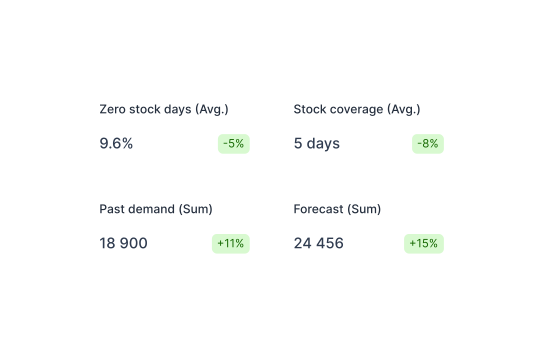
Focus attention on what truly requires action
Less noise. More clarity.
.svg)
Action-oriented indicators
Exception-based views
Anticipate issues and make better decisions, faster
Move from reactive monitoring to proactive decision-making.
.svg)
Predictive supply chain insights
.svg)
Decision-ready dashboards
From reporting dashboards to decision cockpits


How to gain real-time visibility across your operations?
More about Supply Chain dashboards and analytics
Why Supply Chain teams need a unified dashboard

Supply Chain leaders today face a growing challenge: decisions must be taken faster, yet operational data is more fragmented than ever.
Demand signals, inventory levels, supplier performance, logistics constraints, and financial metrics often live in different systems. ERP reports, spreadsheets, and BI dashboards provide partial insights, but rarely deliver the end-to-end visibility needed to manage a modern Supply Chain.
A unified Supply Chain dashboard solves this problem by consolidating operational data into a single decision interface. Instead of spending hours gathering information from multiple tools, planners gain a clear overview of what is happening across the entire network.
More importantly, modern dashboards go beyond simple reporting. When combined with predictive analytics and AI, they help teams anticipate disruptions, identify risks earlier, and prioritize the actions that will have the greatest operational impact.
Platforms like Flowlity bring together key planning processes such as Demand Forecasting, Inventory Management, Supply Planning and more, enabling companies to move from reactive monitoring to proactive decision-making.
Why traditional dashboards are no longer enough for Supply Chain management
Many companies believe they already have dashboards because their ERP or Business Intelligence tools generate reports. In practice, these dashboards often fail to support operational decisions.
The main issue lies in how Supply Chain data is structured and used. Traditional dashboards usually suffer from three major limitations:
Fragmented data sources
Operational data is spread across ERP systems, warehouse platforms, procurement tools, and spreadsheets, making it difficult to obtain a complete view of the Supply Chain.
Static reporting
Most dashboards focus on historical metrics instead of anticipating future risks.
Information overload
When dozens of KPIs appear simultaneously, planners struggle to identify which issues actually require action.
As a result, teams often revert to manual analysis. Planners spend valuable time investigating reports instead of focusing on strategic decisions.
Modern Supply Chain platforms address this problem by introducing exception-based dashboards, where analytics automatically highlight the situations that require attention.
Automation also plays a key role. By combining alerts, predictive analytics, and planning tools, intelligent dashboards drastically reduce manual analysis and improve responsiveness.
How Flowlity provides real-time Supply Chain visibility
Flowlity’s Dashboard and Analytics modules are designed to give Supply Chain teams an immediate and reliable overview of their operations.
Flowlity’s Dashboard tab
When users open Flowlity, the Dashboard acts as the central control panel of the platform. It summarizes the most important operational indicators so planners can quickly assess the health of the Supply Chain before diving into detailed planning decisions.
At the top of the Dashboard, a KPI panel highlights four essential metrics:
- Inventory level, showing the overall stock position across the network
- Zero stock days, identifying periods where products are unavailable
- Stock coverage, indicating how long current inventory will last based on demand
- Past demand, helping planners understand recent demand evolution
Each KPI is displayed with comparisons to previous periods, allowing teams to immediately identify trends and detect anomalies.
Below this KPI panel, time-series charts visualize how key indicators evolve over time. Planners can quickly see whether inventory levels are rising, whether stock coverage is deteriorating, or whether demand trends are shifting.
This high-level visibility makes the Dashboard the natural starting point for daily Supply Chain monitoring.
Flowlity’s Analytics module
When deeper analysis is required, the Analytics module provides a more detailed view of operational data and system performance.
Within Analytics, teams can explore several key areas:
- Data synchronization monitoring, ensuring that demand, orders, and forecasts are up to date
- Data quality reporting, which highlights inconsistencies that could affect planning accuracy
- Global performance overview, aggregating metrics across all sites and warehouses
- Operational alerts, surfacing anomalies and exceptions that require attention
This combination of high-level visibility and advanced analytics allows planners to quickly move from observation to investigation and action.
Because these dashboards are directly connected to Flowlity’s planning modules — including Demand Forecasting, Inventory Management, Supply Planning, and S&OP — insights generated in the dashboard can immediately translate into operational decisions.
Instead of spending time building reports, Supply Chain teams can focus on what really matters: anticipating disruptions and optimizing inventory decisions across the network.
Key Supply Chain KPIs every decision dashboard should track
A well-designed dashboard focuses on the metrics that truly drive Supply Chain performance. While the exact KPIs depend on industry and operational model, several indicators are universally important.
Among the most critical metrics monitored by Supply Chain leaders are:
Service level
Measures the ability to fulfill customer demand without delays or shortages.
Forecast accuracy
Evaluates how closely predicted demand matches actual sales.
Inventory turnover
Indicates how efficiently inventory is replenished and used.
Stockout rate
Tracks how often products are unavailable when customers want them.
Days of inventory on hand
Shows how long existing stock will last based on expected demand.
Cash-to-cash cycle time
Measures how quickly inventory investments convert into revenue.
These indicators help companies balance two critical objectives:
- maintaining high product availability
- minimizing excess inventory and operational costs
The impact of improving these KPIs can be significant when companies gain better visibility and stronger planning capabilities across their Supply Chain.
For example, Saint-Gobain improved its forecast accuracy by 15% at SKU level, while also increasing product availability and service levels across its network. Better forecasts allowed the company to anticipate demand variability more effectively and reduce operational uncertainty.
Other organizations have focused on inventory optimization. Retail and distribution companies such as Sport 2000 and Plum have reduced inventory levels by nearly 40%, demonstrating how improved forecasting and planning processes can significantly lower working capital requirements.
In e-commerce environments, the impact can be even more visible. At La Redoute, the implementation of Flowlity enabled teams to cut inventory levels by 50%, while simultaneously reducing logistics costs and freeing significant warehouse space for operations.
These results illustrate how strengthening core planning processes such as Demand Forecasting and Inventory Management can transform Supply Chain performance. By improving visibility on demand variability and stock dynamics, companies are able to balance service levels with inventory efficiency in a far more sustainable way.
From reporting dashboards to Supply Chain control towers
Traditional dashboards help organizations understand what happened. Modern analytics platforms enable companies to understand what will happen next and what actions should be taken.
This evolution is often described as the transition from dashboards to Supply Chain control towers.
A control tower integrates multiple capabilities:
- real-time operational visibility
- predictive analytics
- automated alerts
- decision recommendations
Instead of presenting isolated metrics, it analyzes the relationships between demand signals, supply constraints, and inventory levels.
For instance, predictive analytics may detect that a spike in demand for a particular SKU could lead to a shortage in several weeks. Planners can then adjust replenishment strategies, redistribute inventory, or revise safety stock levels before the disruption occurs.
This proactive approach significantly improves operational resilience and helps organizations manage uncertainty more effectively.
It also integrates closely with planning processes such as Supply Planning, where operational decisions must adapt quickly to changing conditions.
How Artificial Intelligence enhances Supply Chain analytics
Artificial Intelligence is transforming how dashboards support Supply Chain decision-making.
Instead of relying on static reports, AI continuously analyzes operational data to detect patterns, anticipate disruptions, and guide planning decisions.
Some of the most impactful capabilities include:
Probabilistic demand forecasting
AI models generate ranges of possible demand scenarios instead of single forecasts.
Anomaly detection
Algorithms identify unusual patterns such as demand spikes, supplier delays, or unexpected inventory movements.
Scenario simulation
Companies can test the impact of planning decisions before implementing them.
Decision recommendations
AI systems can suggest actions such as adjusting safety stock levels or modifying replenishment strategies.
These capabilities transform dashboards into true decision intelligence platforms.
For example, scenario modeling allows planners to test the impact of changes in service levels, supplier lead times, or demand volatility. This approach is particularly valuable when combined with Strategic Simulations, allowing planners to test different scenarios and evaluate the impact of disruptions or policy changes before implementing them in real operations. To cope with increasing volatility and uncertainty, businesses must adopt innovative Supply Chain strategies that rethink traditional planning approaches.
Measurable results achieved with AI-driven Supply Chain dashboards
Companies that implement intelligent planning dashboards often see measurable improvements across multiple dimensions of Supply Chain performance.
One of the most visible impacts is inventory optimization. By combining predictive analytics with operational visibility, companies can align stock levels much more closely with real demand patterns. In practice, this means fewer safety stock buffers, better anticipation of demand variability, and more precise replenishment decisions.
Large industrial organizations illustrate this well. Danone, for example, achieved an average inventory reduction of 34% within the first year after implementing AI-driven planning capabilities to optimize raw material and packaging inventories. The platform enabled teams to dynamically adjust safety stock levels and replenishment decisions based on real demand signals rather than static assumptions.
Retail and distribution environments show similar results. At La Redoute, Flowlity helped teams rethink packaging inventory management across multiple warehouses. Within months, the company reduced inventory levels by 50%, while also lowering operational costs and freeing up hundreds of pallets of storage space each month.
Other organizations have achieved comparable gains. Companies such as Sport 2000 and Plum have reduced inventory levels by close to 40%, demonstrating how improved forecasting and planning coordination can significantly reduce working capital while maintaining high product availability.
Beyond inventory optimization, improved visibility also has a direct impact on operational efficiency.
The experience of Camif provides a strong illustration. Before implementing Flowlity, procurement processes were largely manual and forecasting reliability was limited. By introducing data-driven planning and centralized visibility across suppliers and warehouses, the company significantly improved its coordination capabilities. As a result, Camif reduced stockouts by 5 percentage points, generated approximately €40,000 in additional annual revenue by avoiding lost sales, and was able to absorb 44% business growth without increasing logistics headcount.
The operational gains went beyond financial performance. According to the company’s Supply Chain leadership, the platform also generated productivity gains equivalent to one full-time employee, thanks to the automation of previously manual planning tasks and improved decision-making efficiency.
Service performance improvements are another common outcome. When companies gain better visibility across demand, supply constraints, and inventory dynamics, they are able to maintain higher product availability without increasing overall stock levels.
For example, Groupe Lemoine improved its service level by 11%, while Ravate increased product availability by 6.3% through better planning coordination and more accurate demand anticipation.
Taken together, these results highlight a fundamental shift in how Supply Chains are managed. Intelligent dashboards are no longer just reporting tools. When combined with predictive analytics and integrated planning processes, they become operational control systems that help companies anticipate disruptions, prioritize the right decisions, and continuously optimize performance across the entire Supply Chain.
Building an end-to-end Supply Chain dashboard
Creating a powerful Supply Chain dashboard requires more than visualizing KPIs. The real value comes from connecting data across the entire Supply Chain ecosystem.
This means integrating information from:
- suppliers and procurement systems
- production and manufacturing data
- warehouse and logistics operations
- demand signals from sales channels
When these data streams remain isolated, planners struggle to understand how decisions in one area affect the rest of the network.
Modern Supply Chain platforms solve this challenge through seamless integrations with ERP systems, warehouse platforms, and planning tools. This unified data foundation enables dashboards to reflect the true operational situation in real time.
Such visibility is particularly valuable for collaborative processes like Sales & Operations Planning, where demand forecasts, supply constraints, and financial objectives must be aligned.
These challenges often emerge in complex planning environments where demand, supply, and financial objectives must be aligned. Implementing Digital S&OP with AI and automation helps organizations connect these decisions and create a more resilient Supply Chain planning process.
How to choose the right Supply Chain dashboard software
As companies search for better visibility across their operations, many begin evaluating different platforms and technologies. Choosing the best Supply Chain visibility software becomes a key step toward building a more connected and responsive Supply Chain. Selecting the right dashboard solution requires evaluating both technological capabilities and operational impact.
Organizations should consider several key criteria.
First, data integration is essential. The platform must connect easily with existing systems such as ERP, WMS, and procurement tools.
Second, companies should prioritize predictive analytics capabilities. Modern dashboards must go beyond historical reporting and help anticipate disruptions.
Ease of use is another critical factor. If dashboards are too complex, planners will revert to spreadsheets. Intuitive interfaces improve adoption and ensure that insights are used in daily operations.
Scalability is also important. As Supply Chains grow more complex, the dashboard must handle increasing volumes of data and operational scenarios.
Finally, the most powerful solutions integrate analytics with operational planning capabilities such as:
- Demand Forecasting
- Inventory Management
- Supply Planning
This integration allows companies to move seamlessly from insight to action.
FAQ
Find everything you need to know right here.
How does Flowlity's dashboard support Supply Chain decision-making?
Flowlity's dashboard is designed to provide Supply Chain teams with immediate visibility into the most critical operational indicators.
The dashboard summarizes key metrics such as inventory levels, stock coverage, and demand trends, allowing planners to quickly assess the overall health of their Supply Chain. Time-series visualizations help teams understand how these indicators evolve over time and detect emerging risks.
When deeper analysis is required, Flowlity's Analytics module provides additional capabilities, including data quality monitoring, operational alerts, and cross-site performance analysis.
Because the dashboard is directly connected to planning modules such as Demand Forecasting, Inventory Management, Supply Planning, and S&OP, insights generated in the interface can immediately translate into operational decisions. This integration allows organizations to move seamlessly from visibility to action and continuously optimize Supply Chain performance.
What is the difference between a Supply Chain dashboard and a Supply Chain control tower?
A Supply Chain dashboard focuses on monitoring operational KPIs, while a Supply Chain control tower provides a broader and more advanced operational management environment.
Control towers combine several capabilities, including real-time visibility, predictive analytics, collaboration tools, and decision support mechanisms. Their goal is not only to display information but also to orchestrate Supply Chain operations across multiple stakeholders.
While dashboards provide an overview of key metrics, control towers analyze relationships between demand, supply, and inventory data in order to anticipate disruptions and coordinate responses.
In modern Supply Chain platforms, dashboards often serve as the entry point to control tower capabilities, providing the visibility required to guide operational decisions.
How does Artificial Intelligence improve Supply Chain dashboards?
Artificial Intelligence significantly enhances the capabilities of Supply Chain dashboards by transforming them from simple reporting tools into predictive decision-support systems.
AI models can continuously analyze operational data to detect patterns and anomalies that would be difficult to identify manually. For example, algorithms can identify unusual demand spikes, forecast potential stockouts, or detect inconsistencies in data flows.
AI can also generate probabilistic demand forecasts, providing planners with a range of possible scenarios rather than a single prediction. This helps organizations better manage uncertainty and adapt inventory strategies accordingly.
In advanced planning platforms, Artificial Intelligence can also support scenario simulations and generate recommendations that help teams prioritize the most impactful actions.
How do Supply Chain dashboards help reduce inventory?
Supply Chain dashboards help reduce inventory by improving visibility on demand variability, stock dynamics, and replenishment decisions.
When planners have access to accurate and real-time indicators, they can identify situations where inventory levels exceed operational needs. This makes it easier to adjust safety stock levels, optimize replenishment strategies, and avoid unnecessary stock accumulation.
Dashboards also help teams detect slow-moving products and demand fluctuations earlier, allowing them to adapt procurement and production plans accordingly.
Combined with predictive analytics and demand forecasting tools, dashboards provide the insights needed to balance product availability with efficient inventory management.
How does a Supply Chain dashboard improve operational visibility?
Supply Chain dashboards improve visibility by consolidating data from multiple operational systems into a single interface.
In many organizations, information related to demand forecasts, inventory levels, supplier performance, and logistics operations is scattered across different platforms. This fragmentation makes it difficult for planners to obtain a clear and real-time understanding of the situation.
A centralized dashboard connects these data sources and presents them through visual indicators, trend charts, and alerts. This allows Supply Chain teams to identify issues earlier, such as declining stock coverage, unusual demand spikes, or supplier delays.
Better visibility ultimately helps companies move from reactive management to proactive decision-making, enabling planners to anticipate disruptions rather than simply reacting to them.
What KPIs should be included in a Supply Chain dashboard?
The most effective Supply Chain dashboards focus on a limited set of KPIs that directly influence operational performance.
Commonly monitored indicators include service level, which measures the ability to meet customer demand without shortages, and forecast accuracy, which evaluates how closely predicted demand matches actual sales.
Inventory-related metrics are also essential. These typically include inventory turnover, stock coverage, and days of inventory on hand. Together, they help organizations understand how efficiently inventory is managed and whether stock levels are aligned with demand patterns.
Operational indicators such as stockout rate and cash-to-cash cycle time are also frequently included, as they provide insight into product availability and working capital efficiency.
By monitoring these KPIs within a single dashboard, Supply Chain teams can quickly identify imbalances between service level objectives and inventory costs.
What is the difference between a Supply Chain dashboard and Supply Chain analytics?
A Supply Chain dashboard focuses primarily on monitoring performance, while Supply Chain analytics helps analyze data and support decisions.
Dashboards typically display key metrics such as service level, forecast accuracy, stock coverage, or inventory turnover. Their role is to provide a quick overview of operational performance and help teams detect anomalies.
Supply Chain analytics goes further by enabling deeper investigation into the causes of operational issues. Advanced analytics tools can identify patterns in demand variability, highlight data quality issues, or simulate the impact of different planning scenarios.
Modern Supply Chain platforms combine both capabilities. Dashboards provide high-level visibility, while analytics modules allow planners to explore data in detail and identify the actions that will improve performance.
What is a Supply Chain dashboard?
A Supply Chain dashboard is a centralized interface that aggregates operational data and presents key performance indicators in a clear and actionable way. It allows Supply Chain teams to monitor critical metrics such as inventory levels, demand trends, stock coverage, and service levels from a single environment.
Instead of navigating across multiple tools such as ERP reports, spreadsheets, and analytics platforms, planners can quickly understand the current state of operations and detect potential risks. Modern Supply Chain dashboards are designed not only to display KPIs but also to help teams prioritize actions and identify emerging disruptions.
When integrated with planning platforms, dashboards become a daily decision tool that supports better coordination across forecasting, inventory management, and supply planning processes.