.svg)
Kickstart your growth with AI-powered promotion management software
Plan smarter promotions that generate real incremental demand. Align promotions with AI-powered demand forecasts and inventory intelligence to reduce overstocks and protect margins.
Get a DemoStop guessing. Start planning promotions with demand and inventory intelligence.
.svg)
Generate incremental demand with smarter promotions
Focus on promotions that truly grow sales—not just shift volume.
Promotion uplift forecasting

Promotion scenario simulation

Reduce overstocks with inventory-aware promotions
Promotions should help you sell excess stock — not create more of it.
.svg)
Protect margins while driving volume
Drive volume without sacrificing profitability.
.svg)
Margin impact simulation
.svg)
Real-time margin optimization
Promotion strategy optimization
Gain full visibility on promotion performance
Know exactly which promotions work—and which ones don’t.
Full visibility on promotion ROI
Automatic lift calculation
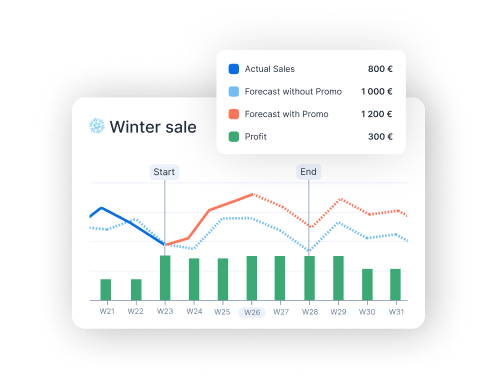
Why Flowlity's promotion management software drives profitable growth
The hidden cost of siloed promotion planning

In most companies, promotions are still driven by marketing or sales teams using disconnected tools. Campaigns are designed to boost demand, but Supply Chain teams often adapt too late. By the time the impact is visible, the damage is already done.
This disconnect creates two recurring problems. First, stockouts during successful promotions — the moment demand peaks, products are unavailable. Second, excess inventory after the campaign — demand didn’t meet expectations, and margins are lost in markdowns.
These are not marketing failures. They are planning failures.
When promotions are integrated with Store Replenishment and Inventory Management, decisions become grounded in reality. You don’t just create demand — you ensure you can fulfill it. Promotions become controlled levers instead of risky bets. The scale of the problem is well documented: McKinsey research finds that 59% of trade promotions globally lose money — and 72% in the United States — making promo execution one of the largest sources of untracked margin leakage in CPG and retail.
What to expect from a high-performance promotion management platform
Many tools claim to manage promotions, but most focus on coordination — workflows, calendars, budgets. That’s useful, but it doesn’t answer the most important question: what will actually happen if we run this promotion?
A high-performance platform answers that question before you commit. It doesn’t just help you plan promotions — it helps you predict, test, and control their impact across your Supply Chain.
Promotion uplift forecasting: understand demand before it happens
At the core of any strong solution is the ability to anticipate how demand will react to a promotion.
Instead of relying on intuition, the system leverages historical data, pricing signals, and seasonality patterns to estimate realistic demand scenarios. This allows planners to move away from rough assumptions and make decisions based on quantified impact.
Behind the scenes, this typically includes:
- baseline vs uplift demand separation
- analysis of past promotion performance
- integration with Demand Forecasting models
The result is simple: fewer surprises, more reliable planning.
Scenario simulation: test decisions before taking risks
Planning a promotion without simulation is like launching a campaign blind.
A high-performance platform allows you to test multiple strategies before execution. You can compare different scenarios — discount levels, campaign duration, product selection — and immediately see their impact on demand, inventory, and margins.
Key capabilities usually include:
- what-if scenario modeling
- comparison of multiple promotion strategies
- impact visualization on inventory and service levels
This shifts planning from reactive to proactive. You don’t adjust after the fact — you choose the best option upfront.
Inventory-aware planning: align promotions with operational reality
One of the biggest gaps in traditional tools is the lack of connection with inventory.
A strong Promotion Management platform integrates directly with Inventory Management and Store Replenishment, ensuring that promotions are aligned with actual stock levels and supply constraints.
This enables teams to:
- avoid launching promotions that will create stockouts
- use promotions to reduce excess inventory
- balance stock across locations
Promotions stop being isolated commercial decisions and become levers to optimize the entire Supply Chain.
Performance visibility: measure what really drives value
Driving sales is not enough — understanding how those sales were generated is what improves performance over time.
A high-performance platform provides clear visibility on promotion outcomes, helping teams distinguish between:
- real incremental demand
- demand shifted in time
- cannibalization across products
With integrated Dashboard & Analytics, teams can track performance in real time and refine future strategies based on actual results, not assumptions.
From static planning to AI-driven promotion optimization
Promotion planning has become too complex for static models. Too many variables interact at once — pricing, seasonality, channels, product dependencies — and traditional tools struggle to capture that complexity. NielsenIQ research finds that 38% of trade promotion spend is wasted due to poor forecasting and inaccurate baseline calculations — a structural inefficiency that AI-driven planning is designed to close.
AI changes that by learning from your data and continuously improving predictions. It doesn’t just automate calculations; it enhances decision-making. This is how companies move from rough estimates to reliable forecasts. For instance, Saint-Gobain improved forecast accuracy at SKU level by 15% with Flowlity — directly translating into better planning decisions and fewer operational surprises.
AI also accelerates planning cycles. What used to take days of manual adjustments can now be tested in minutes. Planners spend less time reacting and more time anticipating.
The result is not just efficiency, but control.
Which companies benefit most from promotion management software?
Not every company needs advanced promotion planning. But if promotions regularly create tension between teams, it’s usually a sign that something is missing.
This is particularly true for companies that:
- manage a large number of SKUs
- operate across multiple channels
- experience demand volatility
- rely heavily on Excel or manual processes
Promotion Management software delivers the most value to companies where promotions directly shape the P&L — and where misaligned promos create as many problems as they solve. Flowlity is built for category managers and trade marketing teams in retail and e-commerce who design multi-SKU, multi-channel campaigns and need to anticipate real incremental demand vs. cannibalization. It fits demand planners in CPG and distribution who take the hit when a successful promo creates stockouts or a failed one generates months of excess inventory. And it supports commercial directors and COOs in mid-market who want their promo investment to convert into sustained growth, not into firefighting.
The common signals this capability is needed: promos that run on Excel and intuition, systematic stockouts on hero items during campaigns, post-promo inventory hangovers that erode margin through markdowns, and no shared view between commercial and Supply Chain teams of what a given promo will actually do to stock.
In Retail & Ecommerce, this complexity increases even further. A single promotion can impact stores, warehouses, and online channels simultaneously. Without a unified planning approach, it becomes almost impossible to keep everything aligned.
If your promotions create as many problems as they solve, it’s time to rethink how they’re planned.
Connecting pricing, demand, and promotions for better decisions
Promotions are not just commercial decisions — they are pricing decisions with operational consequences.
A discount can boost volume, but it can also erode margins if it attracts customers who would have purchased anyway. The real challenge is finding the balance between attractiveness and profitability.
This is why promotion planning must be connected to both Pricing Optimization and Demand Forecasting. You need to understand how customers will react, how demand will shift, and how it will impact your Supply Chain.
Without this connection, promotions are blind. With it, they become strategic.
Why companies choose Flowlity for promotion management
Most solutions treat promotions as isolated workflows. Flowlity treats them as part of a broader Supply Chain system.
This means every promotion is evaluated not just for its commercial potential, but for its operational feasibility.
Before launching a campaign, you can:
- simulate demand impact
- align with available inventory
- anticipate risks such as stockouts or overstock
This changes the role of planning entirely. You’re no longer reacting to outcomes — you’re shaping them.
Flowlity also bridges the gap between commercial and Supply Chain teams. Everyone works from the same data and the same projections, which eliminates misalignment and accelerates decision-making.
If you want to see this in action, take a look at our Camif Supply Chain transformation case study.
Turning promotions into a lever for Supply Chain control
At some point, improving promotions is no longer the main objective. The real goal becomes controlling the impact of decisions across the entire Supply Chain.
Promotions influence demand, inventory, logistics, and customer experience. When they are managed properly, they can reduce excess stock, improve availability, and increase profitability. When they are not, they amplify every weakness in your system.
That’s why leading companies are adopting more agile, data-driven models, as detailed in this agile Supply Chain guide for retailers.
As operations grow, automation becomes critical to automate your Supply Chain to sustain performance.
Promotion Management is no longer a standalone capability. It is part of a broader shift toward smarter, more resilient Supply Chains.
FAQ
Find everything you need to know right here.
What is a Promotion Management Software and how is it different from trade promotion management (TPM)?
Promotion Management Software helps companies plan, simulate, and optimize promotions — but the real difference lies in how closely it is connected to Supply Chain reality.
Traditional Trade Promotion Management (TPM) tools focus on managing budgets, discounts, and commercial agreements between manufacturers and retailers. They answer the question: "how much should we invest in promotions?"
But they often miss a more critical one: "can we execute this promotion without creating stock issues or margin loss?"
Modern Promotion Management platforms — like Flowlity — go further by integrating promotions directly with Demand Forecasting and Inventory Management.
This means every promotion is evaluated not just for its financial potential, but for its operational feasibility.
The result: fewer stockouts, less excess inventory, and promotions that actually deliver profitable growth.
How does a Promotion Management Software improve promotion ROI?
Promotion ROI improves when decisions are based on real impact — not assumptions.
Instead of launching promotions and analyzing results afterward, companies can forecast demand uplift, simulate different scenarios, and evaluate both financial and operational outcomes before execution.
The key difference comes from connecting promotions to Supply Chain planning. When promotions are aligned with Demand Forecasting and inventory constraints, companies avoid the hidden costs that typically destroy ROI: stockouts, overstocks, and last-minute operational adjustments.
It's not just about driving more sales — it's about making sure those sales are profitable and sustainable.
Can promotions be evaluated before execution?
Yes — and this is where modern Promotion Management Software creates immediate value.
Instead of committing to a single plan, teams can test multiple promotion scenarios in advance. Discount levels, campaign duration, product selection — each variable can be adjusted and evaluated before launch.
More importantly, these scenarios are not evaluated in isolation. They are assessed based on their impact on demand, inventory, and service levels.
This allows companies to move from intuition-driven decisions to controlled, data-driven planning.
Can Promotion Management Software reduce stockouts during promotions?
Promotional periods are among the highest-stakes moments in the Supply Chain: demand can triple overnight, customer expectations peak, and every stockout is both a lost sale and a direct hit to brand trust. Getting promotions right operationally is therefore as important as getting them right commercially.
Yes — provided it is connected to Supply Chain planning.
Stockouts during promotions usually happen because demand and inventory are managed separately. Promotions increase demand, but Supply Chain teams don't have enough visibility to anticipate the impact.
By integrating promotions into Demand Forecasting and Store Replenishment, companies can anticipate demand peaks and prepare inventory before the promotion starts.
The result is simple: better product availability when demand is highest, without overstocking elsewhere.
That integration is what unlocks the shift from reactive to proactive: the system models the expected uplift from pricing depth, past comparable promotions, and seasonality, then right-sizes the pre-build at the SKU-location level. For retailers and distributors running frequent promotions, this is usually where the biggest service-level and margin gains come from.
How do you measure promotion performance?
Sales alone don't tell the full story.
A promotion can increase revenue while actually destroying value — for example by shifting demand earlier or cannibalizing other products.
To measure performance properly, companies need to understand what truly drove the results:
- Did the promotion generate incremental demand?
- What was the impact on margins?
- How did it affect inventory levels?
With integrated Dashboard & Analytics, teams gain this level of visibility. They can identify what worked, what didn't, and continuously improve future promotion strategies.
How does a Promotion Management software work in practice?
In practice, Promotion Management Software connects commercial decisions directly with Supply Chain execution.
Teams can design promotion scenarios and immediately simulate their impact on demand, inventory, and service levels. Instead of working with disconnected tools, both commercial and Supply Chain teams rely on the same data and projections.
With platforms like Flowlity, this process becomes continuous. Forecasts are updated dynamically, risks are identified early, and decisions are adjusted before issues occur.
The result is a shift from reactive firefighting to proactive control.
How can retailers improve promotion performance without increasing inventory risk?
Many retailers try to improve promotion performance by increasing discounts or multiplying campaigns. The problem is that this often creates instability: stockouts during promotions and excess inventory afterward.
The real lever is not doing more promotions — it's planning them better.
By connecting promotions with Demand Forecasting and Inventory Management, retailers can anticipate demand more accurately and align inventory with expected sales.
This allows them to improve performance without increasing operational risk.
To go further, you can explore how leading retailers approach this in our Best Retail Inventory Management Software in 2026 guide.
Is it worth investing in a Promotion Management Software for mid-sized companies?
Yes — especially for companies that are scaling and starting to feel the limits of manual planning.
At this stage, complexity increases quickly: more SKUs, more channels, more frequent promotions. Spreadsheets and disconnected tools become difficult to maintain and often lead to costly errors.
Promotion Management Software helps structure planning, improve visibility, and reduce risk without requiring heavy implementation projects.
For mid-sized companies, it's often the fastest way to gain control over growth without adding operational complexity.