.svg)
Tackle demand volatility with AI demand sensing solutions
Keep service levels high in volatile environments with AI-powered, real-time demand sensing.
Get a Demo.webp)
Turn real-time demand signals into immediate actions
Markets are more volatile than ever. Promotions, disruptions and external events create sudden demand shifts that traditional planning systems can’t absorb—putting service levels and inventory at risk. You need to be able to react—and react fast.

Continuous demand signal updates
Intrinsic & extrinsic signal detection
.svg)
AI-driven alerts & prioritization
.svg)

Protect service levels without inflatinginventory with real-time AI Demand Sensing
Demand forecasting builds the baseline. Demand sensing keeps it relevant in realtime—especially when demand becomes unpredictable.
Real-Time Demand Signal Analysis
See how past demand anomalies are automatically cleaned, demand signals are analyzed, and real-time demand insights are generated across the planning hierarchy.
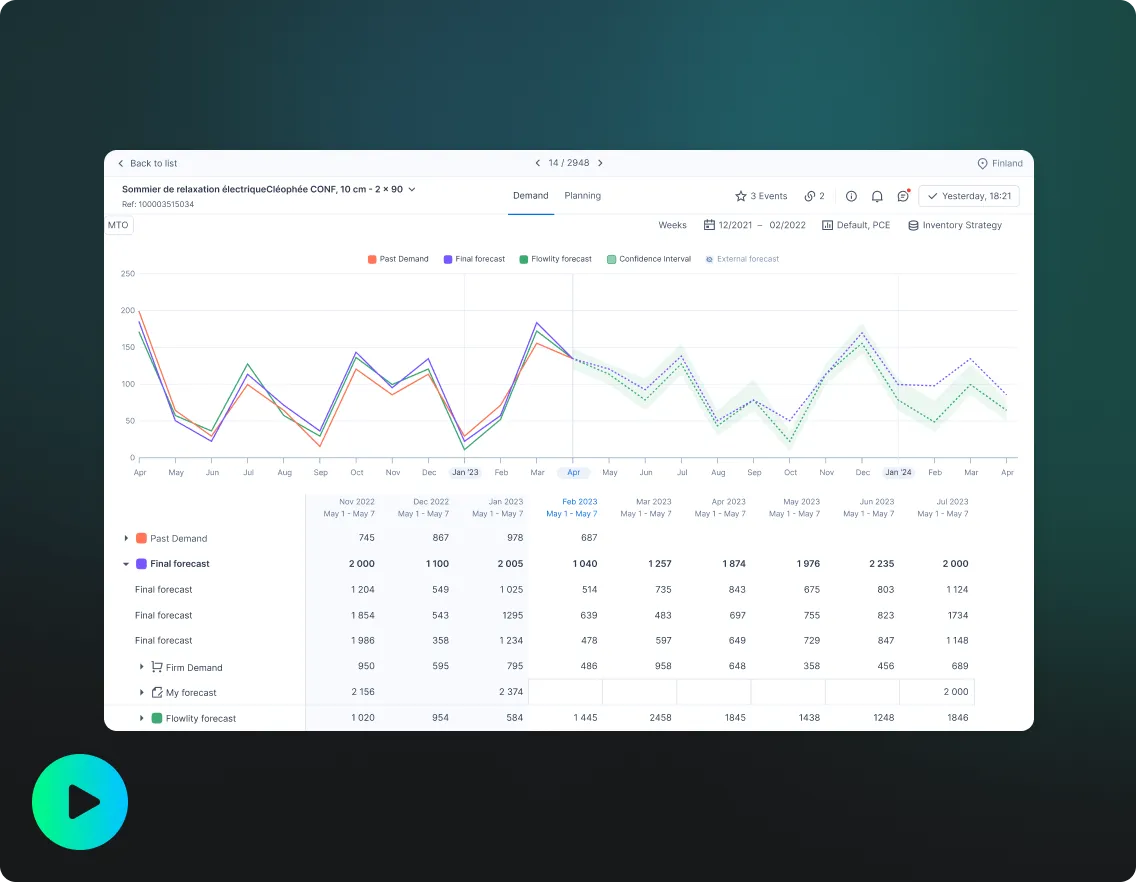

React faster to demand volatility

Avoid stockouts and excess inventory

Reduce firefighting for planners
How Demand Sensing software captures real-time signals to adjust your Supply Chain
Why short-term volatility is the real threat to service levels

Most Supply Chain disruptions don't announce themselves weeks in advance. A sudden spike in sell-through at a key retail location, an unexpected weather event shifting consumer behavior, a competitor stockout redirecting demand to your products — these shifts happen within days, sometimes hours. And by the time a traditional monthly planning cycle catches up, the damage is done: stockouts erode service levels, or excess inventory ties up working capital.
This is where demand sensing in the Supply Chain plays a critical role. Unlike long-range planning methods that rely on historical patterns projected over months, demand sensing operates on a much shorter horizon — typically days to weeks. It continuously ingests real-time signals such as point-of-sale data, order patterns, and external indicators to detect shifts as they emerge. The goal is not to replace your broader demand forecasting process, but to sharpen the near-term picture so your teams can act before volatility turns into lost revenue or waste.
For companies in retail and ecommerce, where promotions, seasonality, and consumer trends shift rapidly, this responsiveness is essential. But the same logic applies in manufacturing environments, where raw material lead times and production schedules require early visibility into demand changes to avoid costly adjustments downstream.
How the demand sensing process works in practice
The demand sensing process can be broken down into a few core steps, each building on the previous one to shorten the gap between a market signal and an operational response.
Signal ingestion
This is the starting point. Demand sensing solutions pull data from a wide range of sources:
- Sell-through and POS data
- Open orders and shipment tracking
- Inventory positions across the network
- External indicators like weather, economic indexes, or event calendars
The more granular and frequent the data, the more accurately the system can detect emerging patterns.
Pattern detection and adjustment
AI and machine learning algorithms analyze these incoming signals against the existing short-term plan. Rather than rebuilding a forecast from scratch, the system identifies deviations — a sudden acceleration in sales velocity for a specific SKU at a specific location, for instance — and adjusts the near-term outlook accordingly. This happens automatically and at a level of granularity (SKU × location × day) that would be impossible to achieve manually.
Actionable output
This is what separates useful demand sensing from mere signal monitoring. The adjusted short-term view feeds directly into replenishment decisions, production scheduling, and inventory management processes. Planners don't need to review every adjustment — they focus on the exceptions and high-impact deviations flagged by the system, which is exactly how Flowlity's AI-driven alerts and prioritization work.
To explore how probabilistic models power this kind of real-time adjustment, the webinar on AI-driven Supply Chain forecasting models and the probabilistic approach goes deeper into the methodology.
What to look for in demand sensing solutions
Not all demand sensing software delivers the same value. When evaluating solutions, several capabilities separate effective tools from those that add complexity without meaningful improvement.
Granularity and frequency of updates
The best demand sensing solutions operate at the SKU-location level and refresh daily or even intra-day. If a tool only updates weekly or works at aggregate product-family levels, the responsiveness advantage disappears.
Signal breadth and flexibility
Your solution should be able to ingest internal data (POS, orders, shipments, inventory) alongside external signals (weather, market indicators, events) without requiring months of custom integration work. Mid-market companies especially need solutions that connect quickly to existing ERP and data sources — this is a core design principle behind Flowlity's plug-and-play architecture.
Explainability and planner trust
Demand sensing only works if planners trust and act on the adjusted signals. Black-box algorithms that produce unexplained changes create resistance. Look for solutions that surface the "why" behind each adjustment:
- Which signal triggered the change
- How confident the model is
- What the expected impact would be
Flowlity addresses this through transparent dashboards and analytics that show exactly which factors are driving each recommendation.
Integration into the broader planning workflow
Demand sensing shouldn't exist as a standalone module disconnected from the rest of your Supply Chain planning. It needs to feed seamlessly into S&OP processes, inventory optimization, and store replenishment — creating a continuous loop rather than a separate data stream.
Demand sensing across industries: from retail shelves to production lines
Demand sensing in the Supply Chain is not a one-size-fits-all capability. The signals that matter, the speed of response required, and the downstream actions differ significantly across industries.
In Retail and ecommerce
In retail and ecommerce, demand sensing is primarily driven by POS and sell-through data. Promotions, competitor pricing shifts, and even social media trends can cause rapid changes in consumer purchasing behavior. The ability to detect a promotion overperforming (or underperforming) within 24-48 hours and adjust replenishment accordingly can mean the difference between capturing incremental revenue and facing empty shelves — or mountains of unsold stock.
For retailers evaluating AI-powered planning tools, the article on the best demand planning software for SMBs provides a useful comparison framework.
In manufacturing
In manufacturing, the signals are different but equally time-sensitive. Order intake patterns, distributor inventory levels, and raw material availability all influence how production schedules should be adjusted in the near term. A manufacturer that detects a sudden uptick in orders from a key distributor can proactively secure raw materials and adjust production runs, avoiding delays and expediting costs.
For a deeper look at how real-time signal detection connects to raw material replenishment, the whitepaper on managing demand volatility and its Supply Chain impact with smarter raw material replenishment explores this in detail.
In both cases, the common thread is speed: reducing the latency between a demand signal appearing in the market and the Supply Chain responding to it.
The measurable impact of demand sensing on Supply Chain performance
The business case for demand sensing software is built on concrete, measurable improvements across several dimensions.
Near-term accuracy improvement
Companies implementing demand sensing typically see a 20% to 40% improvement in short-term (1-14 day) accuracy compared to relying on their baseline plan alone. This isn't about being "more right on average" — it's about catching the specific moments when reality diverges from the plan.
This is exactly what Flowlity's probabilistic engine delivers. Saint-Gobain, for example, improved its forecast accuracy by 15% and increased service levels from 95.8% to 97.2% after deploying Flowlity — translating into fewer missed sales and a sharper read on actual near-term demand across its distribution network.
Service level protection
When your system detects that demand for a product is accelerating beyond plan at a specific location, it can trigger replenishment actions before you hit a stockout. Ravate, a multi-category retailer, improved its service level by 6.3% after deploying Flowlity's demand sensing capabilities — translating directly into protected revenue and stronger on-shelf availability.
Inventory efficiency
Better sensing doesn't just mean stocking more — it means stocking smarter. By identifying when demand is decelerating, companies can avoid over-replenishment and reduce excess. Magotteaux, for instance, reduced its inventory value by 13% and stock coverage by 22% while simultaneously decreasing stockouts by 8% — because the system distinguishes genuine demand shifts from noise.
Planner productivity
Without demand sensing, planners spend significant time manually reviewing forecasts, chasing signals across spreadsheets and dashboards, and firefighting when surprises hit. Automated demand sensing reduces this reactive workload, allowing planners to focus on higher-value activities like exception management and strategic decision-making.
How Flowlity approaches demand sensing differently
Flowlity's demand sensing capability is built on a probabilistic AI engine that doesn't just provide a single adjusted number — it delivers a range of likely outcomes for each SKU at each location, along with a confidence level. This matters because not all signals carry the same weight, and not all demand shifts warrant the same response.
Prioritized alerts, not noise
Rather than forcing planners to blindly trust or manually override every adjustment, Flowlity's approach highlights only the material deviations — the signals that actually require attention. The system captures weak signals from sales trends, promotions, stockouts, weather patterns, and external events, then surfaces them as prioritized alerts. Planners see exactly what changed, why, and what the recommended action is.
Built for mid-market, not just enterprise
This design reflects a core principle: demand sensing should reduce complexity, not add it. Many enterprise-grade solutions in this space require months of implementation and dedicated data science teams to operate. Flowlity is built for mid-market companies that need the same level of AI-powered responsiveness without the overhead:
- Quick to deploy, with pre-built ERP connectors
- Intuitive to use, with no data science team required
- Seamlessly integrated into daily planning workflows alongside inventory optimization and Sales and Operations Planning
Query your demand signals through conversational AI
With the MCP server Flowlity Co-planner, planners can now ask questions about forecast accuracy, demand deviations, and stock levels directly from Claude, ChatGPT, or Microsoft Copilot — in plain English. No dashboards to navigate, no reports to export: the AI assistant queries your live Flowlity data and explains what's happening, including why a specific SKU is deviating from plan.
FAQ
Find everything you need to know right here.
What is demand sensing?
Demand sensing is a short-term Supply Chain capability that uses AI, machine learning, and real-time data signals to detect and respond to changes in demand as they happen. Unlike traditional planning approaches that update monthly or weekly based on historical averages, demand sensing continuously analyzes market signals — point-of-sale data, order patterns, inventory positions, and external factors — to adjust near-term forecasts at a granular level (typically SKU × location × day).
The goal is not to predict demand months out, but to sharpen the next 1–14 days of the plan so that replenishment, production, and allocation decisions reflect what is actually happening in the market. This makes it a powerful complement to the broader demand forecasting process. Flowlity's probabilistic engine is built for exactly this: it continuously recalibrates short-term forecasts at the SKU-location level, giving planners an always-current demand picture without manual rework.
How is demand sensing different from demand forecasting?
Demand sensing and demand forecasting serve different but complementary roles in Supply Chain planning.
Demand forecasting typically operates over a longer horizon — weeks to months — and relies heavily on historical sales patterns, seasonality, and trend analysis to build a baseline plan. It answers the question: what do we expect demand to be over the coming period?
Demand sensing operates over a much shorter horizon — days to two weeks — and focuses on detecting deviations from that plan using real-time signals. It answers a different question: what is actually happening right now, and how should we adjust?
Think of it this way: forecasting sets the course, and demand sensing makes the real-time course corrections. Flowlity combines both in a single platform — the probabilistic engine builds the baseline forecast and continuously adjusts it with real-time sensing, so planners work from one unified view rather than reconciling two separate outputs.
What types of data does demand sensing use?
Demand sensing solutions ingest a wide mix of internal and external data:
Internal signals: point-of-sale and sell-through data, open customer orders, shipment and delivery data, real-time inventory levels across the network, promotional calendars.
External signals: weather data, economic indicators, social-media trends, competitive activity, local events and holidays, market-index movements.
The key is frequency and granularity. Demand sensing works best when data is refreshed daily or more frequently, and when it operates at the individual SKU-location level rather than in aggregated categories. Flowlity's platform ingests all of these signals through pre-built ERP connectors, meaning companies do not need custom data pipelines or dedicated data-engineering resources to start capturing value from demand sensing.
How does demand sensing improve inventory management?
Demand sensing has a direct and measurable impact on inventory performance. By detecting demand accelerations early, it triggers timely replenishment to prevent stockouts. Equally important, when demand decelerates, it prevents over-ordering that leads to excess stock, markdowns, or waste — a critical issue in food, beverage, and perishable goods.
The net effect is a tighter alignment between inventory levels and actual market demand: higher availability with less total stock. Saint-Gobain, for example, achieved a 9.25% reduction in inventory levels with Flowlity, because the system continuously recalibrates the optimal stock position based on real-time signals rather than static safety stock rules.
Can demand sensing work for mid-market companies, not just large enterprises?
Absolutely — and this is precisely where Flowlity operates every day. Historically, demand sensing was accessible only to large enterprises with dedicated data-science teams and multi-year implementation budgets. Today, Flowlity makes demand sensing accessible to mid-market companies through a plug-and-play architecture that connects to existing ERP systems without heavy IT projects.
Flowlity's clients range from 45-person companies like Plum Living, a digital-first furniture brand managing roughly 1,000 SKUs, to industrial manufacturers like Magotteaux and multi-category distributors like Ravate. What they share is the need for AI-driven responsiveness without enterprise-tool complexity. For even smaller teams, Flowlity Lite offers an accelerated path to AI forecasting with minimal setup.
Key criteria for mid-market adoption are: availability of transactional data (orders, sales, inventory), willingness to trust AI-augmented recommendations, and a solution that does not require a team of data engineers to maintain.
Does demand sensing replace Sales and Operations Planning?
No — demand sensing strengthens S&OP, it does not replace it. S&OP is a cross-functional process that aligns commercial, operational, and financial plans over a medium-to-long-term horizon. Demand sensing operates on a much shorter horizon and feeds into that process with more accurate short-term signals.
In practice, demand sensing improves the quality of the demand input that enters the S&OP cycle. When the short-term picture is more accurate, S&OP discussions can focus on strategic decisions and exceptions rather than debating whether the numbers are right. Flowlity is designed with this integration in mind — demand sensing feeds directly into the S&OP workflow, shifting the conversation from "is the forecast accurate?" to "what do we do about the deviations we've detected?".
How quickly can Demand Sensing be implemented?
Implementation timelines vary based on data maturity and Supply Chain complexity. Enterprise platforms can take 6–12 months or more. Flowlity is engineered for fast time-to-value, and real-world deployments prove it.
Plum Living, a 45-person interior design company, went live with Flowlity across 630 SKUs and 2 warehouses — and achieved a 21% inventory reduction at go-live. Supply Caddy, a Flowlity Lite client, generated its first AI forecasts instantly after signing and was fully operational in under two weeks.
Typical mid-market deployments take weeks rather than months, thanks to pre-built connectors for major ERP systems and a cloud-native architecture that eliminates heavy IT infrastructure requirements. The deciding factor is data readiness — if your organization already tracks orders, sales, and inventory at the SKU level in a structured system, the foundations for demand sensing are already in place.