.svg)
Optimize inventory targets across the network with AI-driven multi-echelon inventory optimization
Define optimal inventory targets across your entire supply chain. Balance service levels, inventory costs and demand uncertainty using probabilistic, network-wide optimization.
Get a DemoBalance service levels and inventory costs across the network
Inventory decisions are always a trade-off.
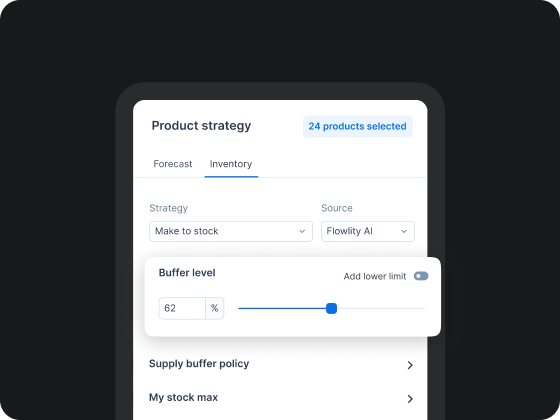
Service-driven inventory targets
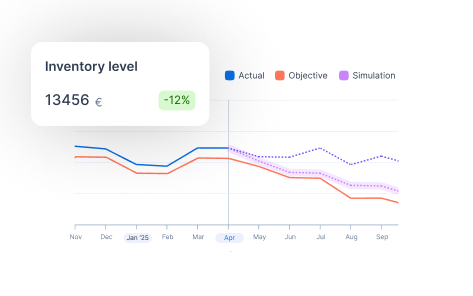
Lower inventory, same service
“Our target of reducing inventory value by 1 million euros was ambitious, yet Flowlity has played a crucial role in achieving this success. We felt heard as the Flowlity team took into account our experience and supported us at each stage of the process.”
Rodolphe Kautzmann
Purchasing Manager at Ukal

Optimize inventory positioning across all echelons
Inventory must work as a system—not node by node.
.svg)
Network-wide inventory optimization
Coherent buffers across the supply chain
Set realistic inventory targets under demand uncertainty
Averages are not enough.
.svg)
Probabilistic safety stock optimization
.svg)
Scenario simulation before committing
From local inventory rules to true multi-echelon optimization


Multi-echelon inventory optimization software: choose, deploy, and maximize impact across your Supply Chain
Move beyond local inventory decisions and regain control of your network

Most inventory strategies are still built locally. Safety stock is defined warehouse by warehouse, often using static rules that fail to reflect how the Supply Chain actually operates. On paper, each node looks optimized. In reality, the network is not.
This disconnect creates a familiar pattern: excess inventory coexists with recurring stockouts, and planners spend more time reacting than anticipating.
This is exactly what companies like Saint-Gobain faced before modernizing their planning approach. Fragmented systems, manual processes, and limited visibility made it difficult to align inventory decisions across the network. You can see how they improved forecast accuracy and service levels in our Saint Gobain Supply Chain Case Study.
Multi-echelon inventory optimization changes the perspective. Instead of optimizing each location independently, it allows you to manage inventory as a system, aligned with the real structure of your Supply Chain.
Align inventory with how your Supply Chain actually operates
A Supply Chain is not a collection of independent nodes. It is a network of dependencies where each decision impacts upstream and downstream performance.
Multi-echelon inventory optimization software captures this reality. It models suppliers, production sites, warehouses, and distribution flows as a single system, then determines how inventory should be positioned across that system.
This shift enables a much more accurate balance between service levels and inventory. Rather than duplicating safety stock everywhere, inventory is placed where it absorbs variability most effectively.
Combined with Inventory Management, this creates a planning model that reflects how operations truly function — not how they are simplified in spreadsheets. It naturally connects with DRP to better coordinate flows across the distribution network.
It also aligns with Supply Planning to ensure inventory decisions remain consistent with production and procurement constraints.
And at execution level, it supports more accurate Store Replenishment by positioning stock where it actually matters.
Turn uncertainty into a lever instead of a constraint
Traditional planning methods try to simplify uncertainty. They rely on average forecasts and fixed parameters, which inevitably leads to overstocking as a safety buffer.
Modern MEIO solutions take a different approach. They embrace uncertainty and model it directly.
Instead of relying on a single forecast, the system evaluates a range of demand scenarios and determines the inventory strategy that performs best across those possibilities. This allows companies to reduce unnecessary buffers while maintaining high service levels.
This is where Artificial Intelligence becomes critical. By continuously learning from historical and real-time data, it enables more accurate and adaptive inventory decisions — turning uncertainty into a source of optimization rather than risk.
From isolated improvements to measurable business impact
Traditional planning methods try to simplify uncertainty. They rely on average forecasts and fixed parameters, which inevitably leads to overstocking as a safety buffer.
Modern MEIO solutions take a different approach. They embrace uncertainty and model it directly.
Instead of relying on a single forecast, the system evaluates a range of demand scenarios and determines the inventory strategy that performs best across those possibilities. This allows companies to reduce unnecessary buffers while maintaining high service levels.
This is where Artificial Intelligence becomes critical. By continuously learning from historical and real-time data, it enables more accurate and adaptive inventory decisions — turning uncertainty into a source of optimization rather than risk.
This is particularly visible in Manufacturing, where inventory, production, and service levels are tightly interconnected.
The same applies in Wholesale industry environments, where stock needs to be balanced across multiple warehouses and regions.
A solution designed for real Supply Chain environments
Choosing a multi-echelon inventory optimization software is not just about algorithms. It is about ensuring the solution works in your operational reality.
The most effective platforms combine advanced modeling capabilities with seamless integration into existing systems. They also work better when paired with multi-tier Supply Chain visibility, because better decisions start with better visibility across suppliers and partners.They act as a decision layer on top of ERP environments, enriching them without disrupting execution processes.
Usability is equally critical. Planners need to understand, trust, and act on recommendations. Without adoption, even the most advanced solution fails to deliver value.
Flowlity was built with this balance in mind: combining powerful optimization capabilities with a user experience designed for day-to-day planning decisions.
Flowlity: a new standard for inventory optimization
Flowlity was designed to address the limitations of traditional planning tools and provide a more adaptive, resilient approach to Supply Chain management.
By connecting data across systems and modeling the full Supply Chain network, Flowlity continuously generates recommendations for inventory positioning and replenishment. This allows companies to move from static planning to dynamic decision-making.
Beyond optimization, Flowlity also improves collaboration across the ecosystem. By sharing relevant signals with suppliers, it enables better alignment and anticipation across all stakeholders.
The result is not just better inventory management, but a more synchronized and responsive Supply Chain. This matters even more in volatile categories like spare parts, where dedicated Spare Parts Inventory Management Strategies help teams avoid both dead stock and critical shortages.
Frequently asked questions about MEIO software
Find everything you need to know right here.
What is MEIO?
MEIO stands for Multi-echelon inventory optimization. It is a Supply Chain planning method that determines optimal inventory levels across multiple locations simultaneously, rather than optimizing each node independently.
It considers the entire network — including suppliers, production sites, warehouses, and distribution centers — to position inventory where it delivers the highest service level with the lowest total stock.
By accounting for demand variability and lead times across the network, MEIO enables companies to reduce inventory while improving service.
How is multi-echelon inventory optimization different from traditional inventory planning?
Traditional inventory planning optimizes each location independently, often using static safety stock rules and average demand forecasts. Every warehouse or store is treated as a silo: its inventory target is set in isolation, with no visibility on what sits upstream or downstream.
Multi-echelon inventory optimization (MEIO) takes a network-wide approach. It explicitly models how inventory decisions at one location impact the rest of the Supply Chain, and dynamically adjusts inventory levels across all nodes together. Instead of each site carrying its own protective buffer, the network holds just enough stock at the right echelons to absorb variability.
The result is fewer duplicated safety stocks across the network and the ability to achieve better service levels with significantly less total inventory.
How do I know if I need multi-echelon inventory optimization?
A few recurring patterns signal that traditional, location-by-location inventory planning has reached its limit. If your teams are constantly tweaking safety stock levels by hand, chasing stock imbalances between warehouses or stores, or struggling to maintain service levels despite sitting on high inventory, those are clear signs.
Other indicators are frequent inter-site transfers to plug stockouts, a long tail of slow-moving SKUs trapped at the wrong location, and planning discussions that revolve around "who needs stock from whom" rather than "how much should we order overall."
MEIO becomes essential as soon as your Supply Chain behaves as a network rather than a set of isolated locations — typically from the moment you operate two or more echelons or run distribution across multiple regions.
What results can companies expect from multi-echelon inventory optimization — and can it reduce inventory without increasing risk?
Companies typically achieve significant improvements in both inventory efficiency and service levels.
In most cases, results include 20% to 40% reduction in inventory, improved product availability, and fewer stockouts — without increasing operational risk.
This is possible because multi-echelon inventory optimization does not simply reduce stock. It redistributes inventory more intelligently across the Supply Chain, placing it where it absorbs variability most effectively instead of duplicating safety stock everywhere.
As a result, companies can reduce excess inventory while maintaining — or even improving — service levels.
For example, organizations like Danone, La Redoute, and Plum Living achieved substantial inventory reductions while improving operational performance using Flowlity.
How long does it take to implement a MEIO solution?
Implementation timelines vary widely depending on the solution architecture. Traditional MEIO tools, typically built on heavy enterprise planning suites, can take 6 to 18 months and often require dedicated data science resources to configure and maintain the models.
Modern AI-driven platforms like Flowlity are designed for faster deployment and much quicker time-to-value. Pre-built ERP connectors, a planner-centric interface, and a cloud-native architecture let mid-market companies go live in weeks rather than months.
Plum Living, for example, rolled out Flowlity across 630 SKUs and 2 warehouses, achieving a 21% inventory reduction at go-live. The key prerequisite is data readiness — if inventory, orders, and sales are already captured at the SKU-location level, implementation moves fast.
What makes Flowlity different from other MEIO solutions?
Unlike traditional planning tools that rely on deterministic models — one forecast, one fixed inventory target — Flowlity uses probabilistic Artificial Intelligence to model demand uncertainty explicitly. Every SKU at every location is represented by a range of likely outcomes and a confidence level, so inventory decisions reflect real variability rather than a single best guess.
This probabilistic engine continuously adapts inventory targets as new data arrives, without requiring manual re-parameterization.
Combined with fast deployment through pre-built ERP connectors and a planner-centric interface built for mid-market teams rather than large data science groups, the approach delivers measurable results quickly: higher adoption from planners who can see the "why" behind each recommendation, and more resilient Supply Chain planning compared to legacy systems that struggle as volatility increases.
Will my planners actually use the tool?
Adoption is the single biggest factor determining whether a MEIO project delivers value — a sophisticated model that planners ignore is worth less than a simpler one they actually use. For that reason, a MEIO solution has to be transparent, intuitive, and aligned with how planners already work day to day.
Flowlity is designed around that principle. Every recommendation comes with an explanation of which signals drove it — demand trend, variability, lead time, inventory coverage — so planners can see the "why" behind each suggested order. Routine decisions are automated, exceptions are clearly flagged, and planners always remain in control of the final call.
The result is a tool teams trust and rely on, rather than one imposed on them from above.