.svg)
Smarter production with AI-powered MRP software
Move beyond rigid, legacy MRP. Align material replenishment with AI-powered demand forecasts to secure production while freeing up working capital.
Get a Demo
Avoid material shortages that block production
Keep production running, even when demand fluctuates.
.svg)
Demand-driven material requirements
Lead-time-aware replenishment
Reduce excess inventory and free up cash
Stop overbuying “just in case”.
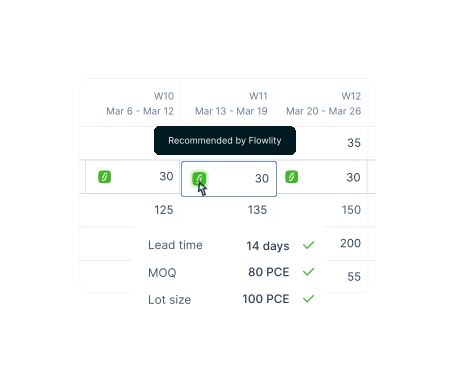
Smarter order quantity recommendations
Inventory risk visibility
Replace spreadsheet-based MRP with reliable automation
Less manual work. More reliable decisions.
.svg)
Automated replenishment calculations
.svg)
Single source of truth
Adapt material planning when reality changes
Because demand and supply never stay still.
Continuous replanning
Exception-based alerts
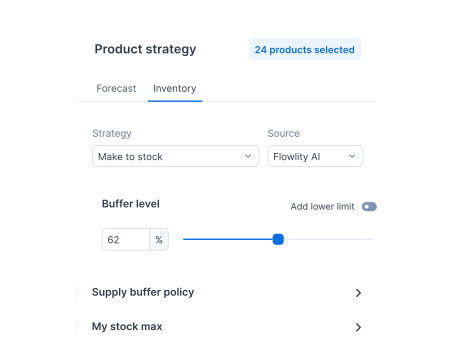
From rigid MRP to intelligent replenishment


MRP software for manufacturing: smarter material planning in a volatile Supply Chain
Learn more about benefit MRP software and how Flowlity is different
Why modern material planning requires more than traditional MRP

Material Requirements Planning was originally designed to answer a simple operational question: what materials should be ordered, when, and in what quantity? For decades, this logic worked well in relatively stable industrial environments where demand was predictable and supply disruptions were rare.
Today, however, most manufacturers operate in a far more volatile Supply Chain. Demand fluctuations, raw material shortages, longer supplier lead times and increasing SKU complexity make static planning models increasingly fragile.
Traditional MRP tools — often embedded in ERP systems — typically rely on deterministic forecasts and fixed planning rules. When demand deviates from expectations or when suppliers delay deliveries, planners must manually adjust parameters, recalculate replenishment quantities, or compensate by increasing safety stock.
This reactive approach creates a structural trade-off. Companies either maintain large inventories to protect production continuity, or reduce stock levels and expose themselves to shortages.
Modern MRP software aims to remove this dilemma by introducing dynamic planning capabilities. Instead of running rigid calculations once per week or month, intelligent planning systems continuously adapt replenishment decisions based on demand signals, supplier constraints and inventory dynamics.
The objective is not only to calculate material requirements more accurately, but to transform MRP into a proactive planning capability connected to the entire Supply Chain planning process.
How MRP software calculates material requirements
To understand the value of modern MRP software, it helps to look at how the calculation logic actually works.
Material Requirements Planning transforms demand signals into operational decisions. The system analyzes multiple inputs across the Supply Chain to determine what materials should be ordered, when they should be ordered, and in what quantity.
The calculation typically starts with the demand forecast. This forecast represents the expected consumption of finished products over time. From there, the system expands the demand through the Bill of Materials, identifying every component required to manufacture those products.
Inventory data is then incorporated into the calculation. The system evaluates current stock levels, incoming purchase orders and production orders already in progress.
Finally, supplier lead times determine when replenishment must be triggered to ensure materials arrive before production begins.
From these inputs, the system generates several operational outputs:
- purchase order recommendations
- production orders
- projected inventory levels
- replenishment alerts when stock risks appear
Modern planning platforms enhance this traditional logic by combining it with demand forecasting, inventory optimization and Supply Planning processes.
This integration allows companies to move beyond static calculations and adopt a more adaptive planning model.
How to choose the right MRP software
Choosing an MRP solution is not only a technology decision; it is a strategic choice that shapes how planning teams operate every day.
Many software vendors position themselves as MRP providers, yet their capabilities can differ dramatically depending on how they approach forecasting, planning automation and Supply Chain visibility.
One of the first criteria to evaluate is the ability to integrate demand forecasting with material planning. In many legacy systems, forecasting and replenishment are disconnected processes. Forecasts are produced in one tool while planning decisions are calculated elsewhere, forcing planners to manually reconcile both datasets.
Modern planning platforms combine these capabilities so that demand signals immediately influence replenishment decisions. This tight integration becomes particularly important when coordinating material planning with upstream production constraints such as Production and Capacity Planning.
Another critical aspect is how the system handles uncertainty. A solution that simply applies fixed safety stock rules may struggle to support volatile environments. Advanced platforms instead rely on probabilistic forecasts and dynamic inventory policies, allowing planners to anticipate demand variability rather than react to it.
Usability also plays a decisive role. Planning teams must be able to understand recommendations quickly and simulate alternative decisions when conditions change. If the system requires complex configuration or heavy IT support, adoption within operational teams will often remain limited.
Finally, companies should evaluate how well the MRP software connects with broader planning and Inventory Management processes, which ensures that replenishment decisions remain aligned with procurement strategies and supplier constraints.
Key features to look for in modern MRP software
The capabilities of MRP solutions have evolved significantly in recent years. While traditional systems focused primarily on calculating replenishment orders, modern planning platforms provide a much broader decision-support environment for Supply Chain teams.
One of the most valuable features is dynamic inventory optimization. Instead of relying on fixed safety stock parameters, advanced systems continuously adapt inventory buffers based on demand variability and supplier lead times. This allows companies to reduce excess stock while maintaining service levels.
Another important capability is real-time stock projection. Planners should be able to visualize how inventory will evolve over time depending on demand forecasts, confirmed orders and recommended replenishments. These projections help teams anticipate shortages or overstock risks before they impact operations.
Modern systems also enable scenario simulation. Planning teams can test alternative replenishment strategies — for example adjusting order quantities or supplier allocations — and immediately observe the impact on stock trajectories.
Visualization tools play a crucial role here. Clear analytical interfaces such as a Supply Chain dashboard & analytics allow planners to monitor inventory risks, supplier performance and demand trends without relying on manual spreadsheets.
Another differentiating capability is the integration between planning decisions and operational execution. Once replenishment recommendations are validated, they must seamlessly translate into purchase orders or supply orders through Supply Order Management tools.
When these features are combined within a single environment, the MRP system becomes not only a calculation engine but a true planning cockpit for Supply Chain teams.
Market evolution: from static MRP to intelligent planning
From stable planning environments to volatile Supply Chains
The evolution of MRP software reflects broader changes in manufacturing Supply Chains.
Historically, material planning systems were designed primarily to support stable production environments where demand variability was relatively limited. The focus was therefore on ensuring that components were available for production while minimizing shortages.
Today, however, planning must operate in a context where uncertainty is the norm rather than the exception. Raw material shortages, demand volatility and global sourcing disruptions require systems capable of reacting dynamically to changing conditions.
The rise of AI-driven planning
Artificial Intelligence plays a central role in this transformation. AI-driven forecasting models generate probabilistic demand scenarios rather than single forecast values, allowing planners to better understand variability and adjust replenishment strategies accordingly.
This shift also changes how companies think about planning processes. Instead of relying solely on MRP calculations, organizations increasingly integrate material planning with broader Supply Chain coordination mechanisms such as Distribution Requirements Planning (DRP), which helps synchronize product flows across distribution networks.
Manufacturers exploring these new planning approaches often begin by understanding how demand volatility affects replenishment strategies. A useful perspective on this challenge can be found in our whitepaper Managing demand volatility and its Supply Chain impact with Smarter Raw Material Replenishment, which explains how smarter replenishment policies stabilize material flows.
From MRP I to modern intelligent planning
Another important evolution of material planning concerns the historical distinction between MRP I and MRP II.
MRP I originally focused on calculating material requirements based on demand forecasts and Bills of Materials. MRP II expanded this logic by incorporating additional operational dimensions such as production capacity, workforce planning and financial planning.
Modern planning platforms extend these concepts even further by integrating Artificial Intelligence, advanced forecasting and Supply Chain coordination capabilities.
Rather than separating forecasting, inventory optimization and production planning, these systems bring them together into a unified planning environment.
Why Flowlity brings a new approach to MRP planning
Flowlity rethinks MRP by combining forecasting, inventory optimization and replenishment planning within a single AI-driven platform.
Instead of running periodic calculations based on static assumptions, the platform continuously analyzes demand signals and Supply Chain constraints to generate adaptive planning recommendations.
At the core of this approach is the Planning environment where demand forecasts are translated into operational supply decisions. Planners can visualize projected stock trajectories, evaluate recommended orders and immediately understand how inventory will evolve depending on demand conditions.
The system displays a clear inventory corridor defined by dynamic minimum and maximum stock levels. As long as projected stock remains within this corridor, the inventory policy is considered optimal. When stock is predicted to fall outside these boundaries, the platform automatically highlights the issue and suggests corrective actions.
Because the planning interface combines forecasting data with replenishment recommendations, planners gain a complete view of the decision process. They can simulate order adjustments, test alternative supplier strategies and observe the impact on stock levels in real time.
This approach allows planning teams to move beyond reactive spreadsheet adjustments and adopt a more proactive planning methodology supported by Artificial Intelligence.
Companies seeking to understand how such planning innovations help prevent disruptions can explore the webinar "How to prevent Supply Chain disruptions", which explains how modern planning technologies go beyond traditional MRP capabilities.
Real-world impact of intelligent MRP planning
The impact of advanced material planning becomes particularly visible when organizations operate large and complex product portfolios.
In industrial manufacturing environments, small forecasting errors can cascade through Bills of Materials and rapidly generate shortages across multiple components. Improving forecast reliability and replenishment accuracy therefore has a direct impact on both service levels and inventory efficiency.
For example, Saint-Gobain improved forecast accuracy at SKU level while simultaneously reducing inventory by around forty percent after implementing more advanced planning practices. This combination of improved visibility and optimized inventory policies significantly reduced the risk of emergency shipments caused by material shortages.
In another context, the furniture company Plum Living was able to reduce the value of its inventory by nearly forty percent. Rather than simply cutting stock levels, the company improved planning precision so that materials arrived closer to the moment they were actually required.
These examples illustrate a broader principle: better planning does not merely reduce inventory; it also stabilizes production operations by ensuring that the right materials are available when needed.
Organizations facing structural raw material shortages often explore broader resilience strategies. The whitepaper Resilience in Supply Chain Facing Raw Material Shortages provides additional insights into how companies strengthen Supply Chain resilience when supply conditions become uncertain.
Strategic adoption: integrating MRP into end-to-end Supply Chain planning
For many manufacturers, the true value of modern MRP software emerges when it becomes part of a broader planning ecosystem.
Material planning must be aligned with upstream production decisions and downstream distribution strategies. When these planning layers operate independently, companies often experience conflicting priorities between inventory reduction and service level objectives.
By integrating MRP calculations with Production Planning, Supply Planning and distribution coordination processes, organizations can build a more synchronized planning model.
This integrated approach is particularly relevant in sectors such as the Manufacturing sector or the Automotive sector, where product complexity and supplier dependencies create strong interdependencies across planning processes.
When planning tools share the same data foundation and analytical models, decision-making becomes faster and more coherent across the entire Supply Chain.
FAQ
Find everything you need to know right here.
How long does it take to implement modern MRP software?
The timeline for MRP software implementation depends heavily on the solution chosen and the complexity of the Supply Chain environment.
Traditional MRP modules embedded in ERP systems often require long implementation cycles — sometimes 6 to 18 months or more — due to customization, data migration, and system integration requirements.
Modern, cloud-based MRP software like Flowlity is designed for faster deployment. Because these solutions work alongside existing ERPs rather than replacing them, implementation timelines are significantly shorter — often measured in weeks rather than months.
Flowlity’s approach focuses on rapid data integration and incremental rollout, allowing Supply Chain teams to start improving material planning performance quickly without waiting for a full system overhaul.
How does material planning work in Flowlity?
In Flowlity, material planning is driven by AI-powered demand forecasts combined with probabilistic inventory models.
Rather than relying on fixed safety stocks and static reorder points, Flowlity continuously recalculates material needs based on evolving demand signals, supplier lead times, and inventory positions across the network.
This means replenishment suggestions are always aligned with the latest Supply Chain conditions — not based on assumptions made weeks or months earlier.
Flowlity also provides planners with clear visibility into which materials are at risk of shortage and which have excess coverage, enabling more targeted and confident planning decisions.
The result is a material planning process that adapts dynamically, reduces manual intervention, and supports better purchasing and production decisions.
How does modern MRP software improve Supply Chain planning?
Modern MRP software improves Supply Chain planning by replacing rigid, rule-based logic with intelligent, data-driven approaches.
Traditional MRP systems rely on fixed safety stocks, static lead times, and manual forecast adjustments. Modern solutions use AI-powered demand forecasting, probabilistic inventory models, and real-time data integration to generate more accurate and adaptive material plans.
This allows Supply Chain teams to respond faster to demand changes, supplier disruptions, and inventory imbalances — without constantly reworking plans manually.
Modern MRP software also provides better visibility across the Supply Chain, helping planners understand not just what materials are needed, but when, where, and why — enabling smarter purchasing and production decisions.
What is the difference between MRP and ERP?
MRP (Material Requirements Planning) focuses specifically on planning what materials are needed, when they should be ordered, and in what quantities to support production or distribution.
ERP (Enterprise Resource Planning) is a broader system that covers multiple business functions — including finance, procurement, manufacturing, HR, and sometimes Supply Chain planning.
Most ERP systems include a basic MRP module. However, these built-in MRP modules often rely on simplified logic (fixed safety stocks, static lead times) and lack the advanced forecasting and optimization capabilities offered by dedicated MRP software.
Modern MRP solutions, like Flowlity, are designed to complement ERP systems — not replace them. They integrate with existing ERPs to enhance material planning with AI-driven forecasting, probabilistic inventory models, and real-time visibility.
What is an MRP software?
MRP software (Material Requirements Planning) is a Supply Chain planning tool used to determine which materials are needed, when they should be ordered, and in what quantities to meet production or distribution requirements.
Traditional MRP modules are often embedded within ERP systems and use deterministic logic — fixed safety stocks, static lead times, and manual forecast inputs — to generate material plans.
Modern MRP software goes further by integrating AI-driven demand forecasting, probabilistic inventory optimization, and real-time data to create more accurate and adaptive replenishment plans.
These advanced capabilities help Supply Chain teams move beyond reactive planning and build material strategies that anticipate demand changes, supplier variability, and inventory risks.